
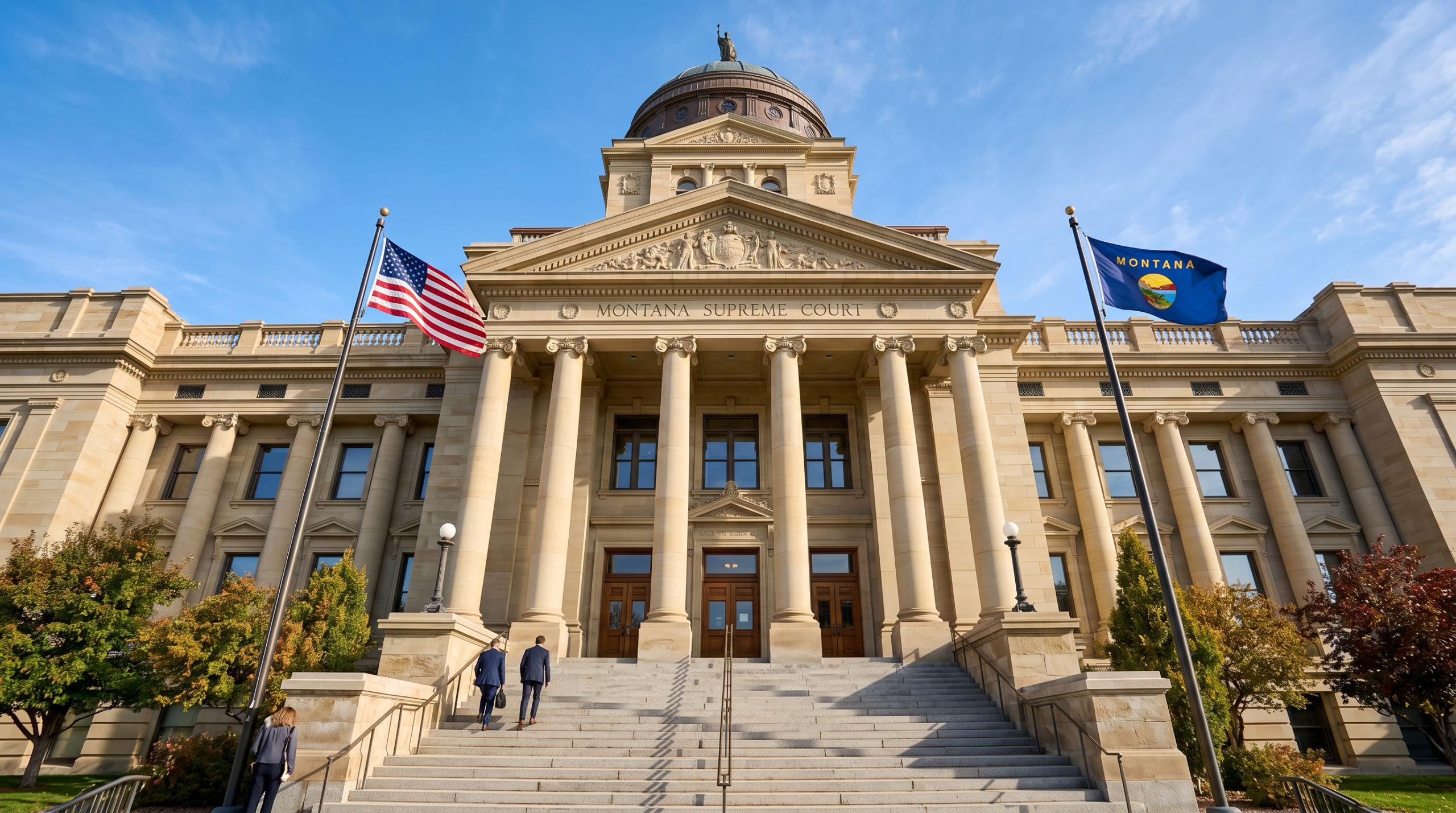
Montana’s Supreme Court has certified a ballot statement for a November voter initiative that would prohibit corporations and other artificial entities from spending money to influence elections, marking a significant development in ongoing efforts to limit corporate political spending at the state level.
The court’s decision, issued Tuesday, represents the latest chapter in a legal battle spearheaded by the Transparent Election Initiative and Jeff Mangan, a former state commissioner of political practices. The proposed measure, known as CI-135, seeks to amend Montana’s constitution to explicitly define the powers of artificial persons, including corporations, and exclude election spending from those powers.
The initiative emerges as part of broader efforts to circumvent the 2010 Citizens United v. Federal Election Commission ruling, in which the U.S. Supreme Court determined that restrictions on corporate political spending violated First Amendment free speech protections. Since that landmark decision, various states have explored alternative approaches to regulate corporate influence in elections.
In Tuesday’s ruling, Justice James Jeremiah Shea, writing for the court, approved Attorney General Austin Knudsen’s revised ballot statement with one modification. The court removed a sentence it deemed argumentative, while upholding Knudsen’s authority to revise ballot statements when they fail to meet legal requirements.
The path to certification has been contentious. After the Supreme Court rejected Knudsen’s initial attempt to disqualify the measure in April, the attorney general was ordered to prepare a ballot statement. The Transparent Election Initiative submitted its own proposed language, describing how the measure would create a new constitutional article defining artificial persons and their powers, specifically excluding the ability to spend money influencing elections.
Knudsen rejected the group’s proposed statement, arguing it would mislead voters about the measure’s scope. He submitted an alternative version, which the initiative’s supporters challenged as inaccurate and prejudicial.
The court examined three primary issues in its review: whether Knudsen exceeded his authority in rewriting the statement, whether his version violated procedural requirements by being inaccurate or prejudicial, and whether the court should reject or modify the statement.
On the first issue, the court sided with Knudsen, finding that the attorney general possessed statutory authority to reject and revise ballot statements deemed deficient. The court noted that the Transparent Election Initiative failed to identify any legal provision limiting this power.
Regarding accuracy concerns, the court addressed disputes over terminology, particularly the use of the word “prohibition.” While the initiative’s supporters argued the measure merely specifies the scope of corporate powers rather than imposing prohibitions, Justice Shea characterized this as a semantic disagreement, comparing it to debating whether a glass is half-full or half-empty.
However, the court did take issue with one portion of Knudsen’s statement. The problematic sentence suggested that artificial persons would have no powers under the state constitution beyond those explicitly granted by the state. The court found this language potentially misleading, as it could lead voters to believe the measure would revoke constitutional rights rather than define the scope of powers.
With this single modification, the court certified the revised ballot statement for submission to the secretary of state, clearing a crucial procedural hurdle for the measure’s appearance on November ballots.
The initiative reflects ongoing tensions between campaign finance reform advocates and those who view spending restrictions as violations of free speech principles. If approved by voters, Montana would join other states attempting to establish state-level limitations on corporate electoral influence despite federal precedent.
The measure’s prospects remain uncertain, as voters will ultimately decide whether to adopt these constitutional changes limiting corporate political spending in Montana elections.
Leave a Reply