
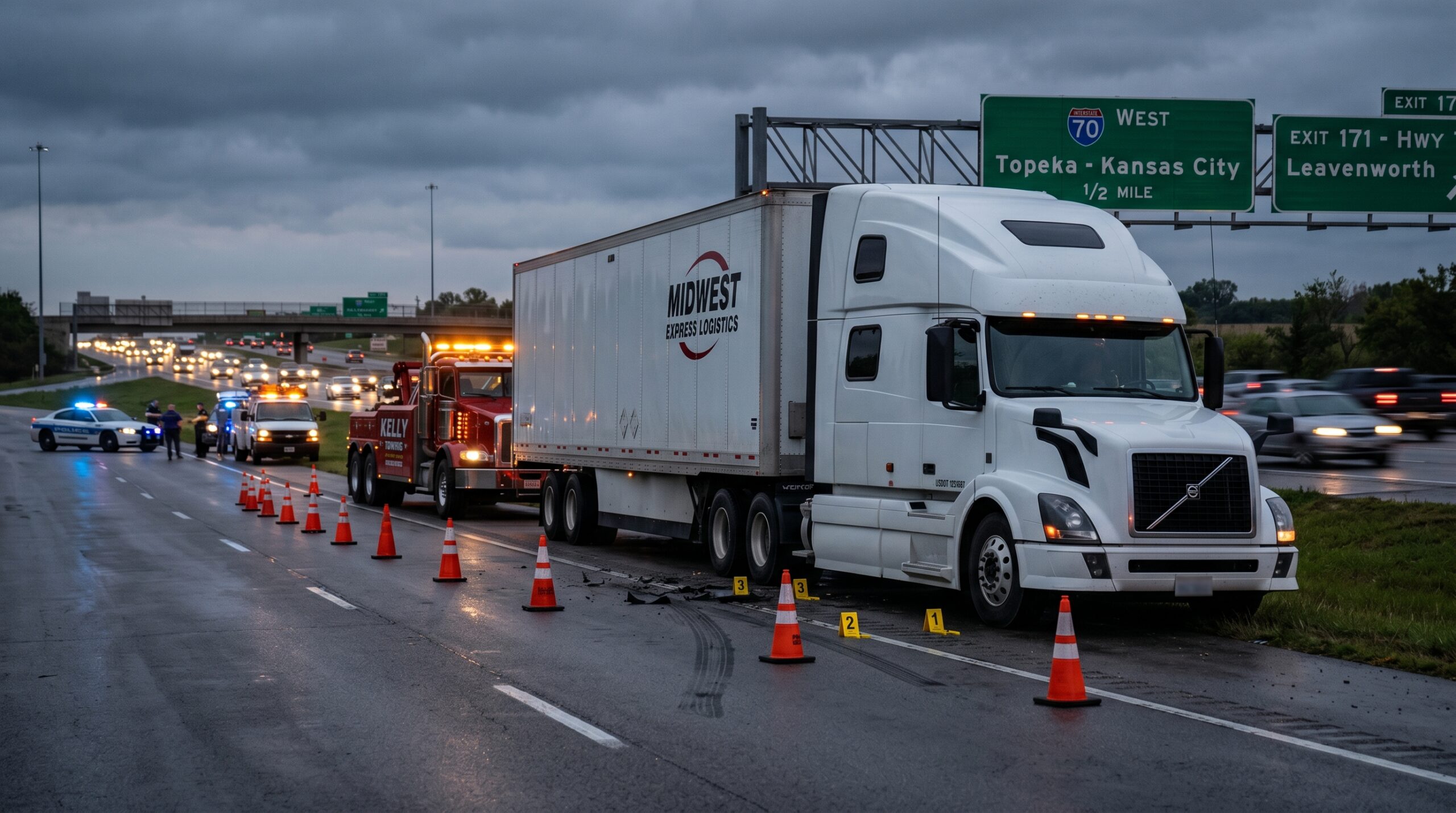
WASHINGTON — The Supreme Court on May 14, 2026, held that a freight broker can be subject to state-law negligent-hiring claims arising from a 2017 tractor-trailer crash that resulted in the amputation of a truck driver’s lower leg. Justice Amy Coney Barrett wrote the unanimous opinion, finding that a safety exception to a federal statute allows states to regulate motor vehicle safety in some circumstances.
The case began with a 2017 collision on Interstate 70 in Illinois. Shawn Montgomery’s tractor-trailer was parked on the highway’s shoulder when another truck, driven by Yosniel Varela-Mojena and operated by Caribe Transport, struck Montgomery’s vehicle at speed. Montgomery suffered severe injuries, including the loss of his lower leg, court records show.
Montgomery sued C.H. Robinson, a freight broker that had hired Caribe Transport, alleging negligent hiring of both the carrier and its driver. Montgomery’s complaint pointed to safety problems: Varela-Mojena had been involved in a prior incident months earlier in which he was accused of operating carelessly, and Caribe Transport — a small carrier operating nine trucks — had been involved in three reported crashes in a roughly three-month period before the 2017 collision, court filings show.
C.H. Robinson sought dismissal under the Federal Aviation Administration Authorization Act (FAAAA), a 1980s-era federal law intended to prevent states from reimposing economic regulation of motor carriers that Congress had removed. The FAAAA includes a safety exception, and the question before the justices was whether that exception preserved Montgomery’s state-law claims against a broker.
Two lower courts had dismissed Montgomery’s claims under the FAAAA. When the Supreme Court took the case in March, the scope of the safety exception and whether it reached a broker’s conduct were central issues.
In the opinion for a unanimous Court, Barrett stressed the limited reach of the ruling. She wrote that Congress “designed the safety exception ‘to ensure that its preemption of states’ economic authority over motor carriers of property [did] ‘not restrict’ the preexisting and traditional state police power over safety.’” Barrett added that the safety exception “saves only a subset of preempted claims: those involving regulations concerning motor vehicle safety,” and cautioned that many state laws concerning prices, routes or services would not fall under the exception.
Justice Brett Kavanaugh wrote a separate concurring opinion, joined by Justice Samuel Alito. Kavanaugh said he would have framed the decision more narrowly and expressed worry about potential cascading liability for brokers who, he said, could face significant litigation and insurance costs. He acknowledged, however, that Congress likely did not intend for brokers to be exempt from meaningful safety-related regulation.
The Transportation Intermediaries Association (TIA), which represents third-party logistics firms and freight brokers, criticized the ruling. TIA President and CEO Chris Burroughs said the decision places an “impossible task” on brokers by requiring them to evaluate carrier safety despite federal licensing. “This is like asking travel agents to evaluate the safety of a given airline despite the fact that the airline has been licensed to fly by the federal government,” Burroughs said, adding that brokers typically lack access to the records and data needed to perform the safety assessments plaintiffs’ lawyers contend they must.
The Supreme Court’s ruling allows Montgomery’s state-law claims to proceed against C.H. Robinson, while underscoring that its holding is confined to safety-related matters preserved by the FAAAA’s exception.
Leave a Reply