
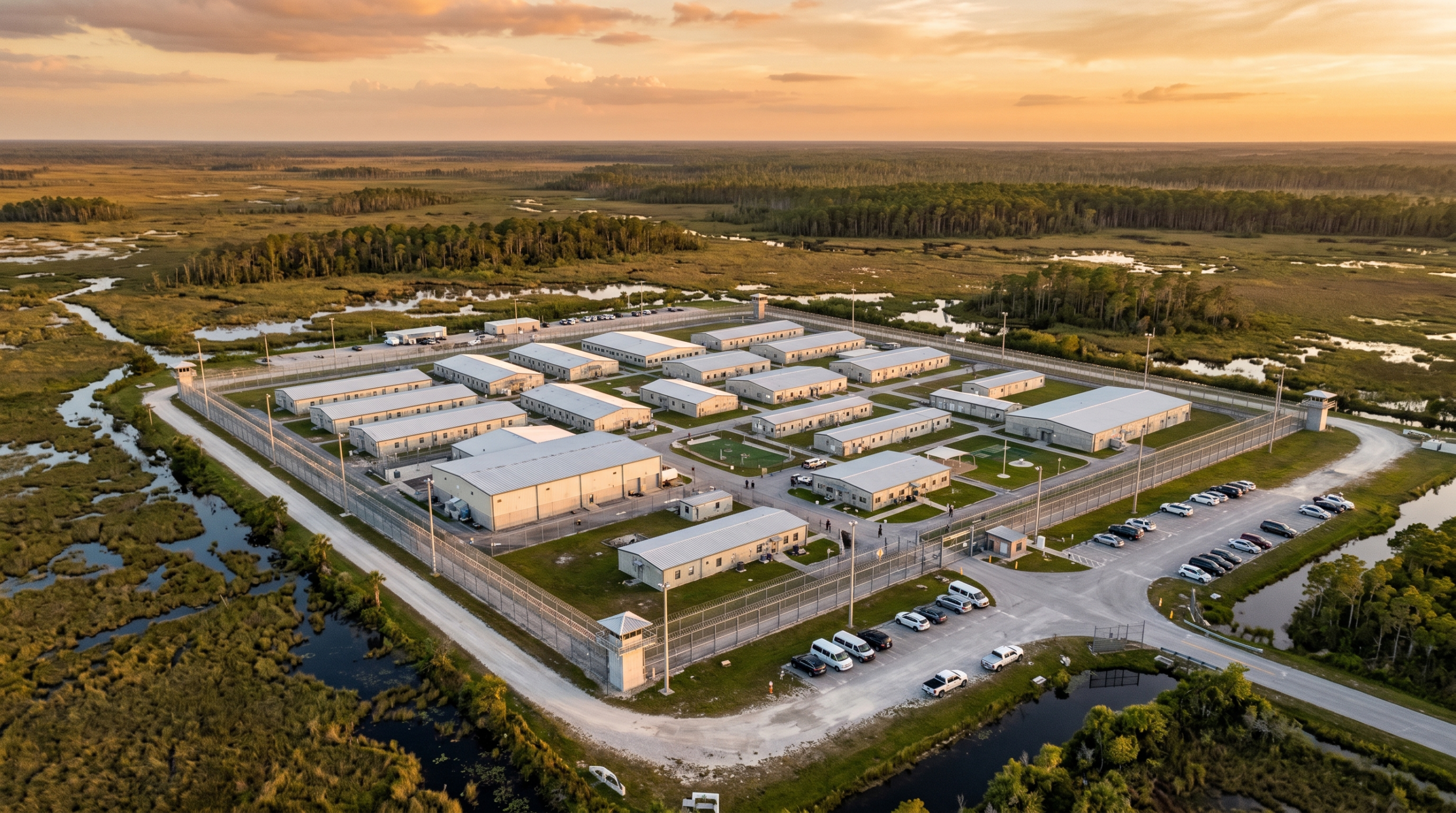
A federal appeals court has ruled that a migrant detention center located in the Florida Everglades will continue operating, rejecting efforts by environmental groups and the Miccosukee Tribe of Florida to shut down the facility they refer to as “Alligator Alcatraz.”
The 11th Circuit Court of Appeals issued a 2-1 decision on Tuesday that overturned a lower court’s order requiring the transfer of detainees and dismantling of the facility within 60 days. The majority opinion determined that the injunction exceeded appropriate judicial boundaries.
Chief Circuit Judge William Pryor, writing for the majority, emphasized that Florida state officials, not federal authorities, constructed and control the facility. The judge noted that the state built the center entirely at its own expense and maintains control over the land. According to the ruling, any federal involvement would be indirect at most, with Florida officials having the ultimate authority over the site’s dedication for immigration purposes.
The legal battle began in June 2026 when Friends of the Everglades, the Center for Biological Diversity, and the Miccosukee Tribe of Florida filed a lawsuit claiming that state and federal officials constructed the detention center without conducting the environmental review required under federal law. In August 2025, District Judge Kathleen Williams had sided with the environmental groups, ordering officials to remove inmates and dismantle infrastructure including generators, lighting, and sewage systems.
Florida Attorney General James Uthmeier promptly appealed the decision, arguing that the Florida Division of Emergency Management operates the facility and that it had not received federal funding. The appeals court’s ruling supports this position, noting that while the Department of Homeland Security authorized $608 million in October for reimbursement of operational costs, these funds have not been released.
The majority opinion also addressed claims about Florida’s 287(g) agreement with U.S. Immigration and Customs Enforcement, which allows local law enforcement to implement certain immigration enforcement measures. The court determined that requiring federal approval for a specific use does not establish federal control over the project.
Circuit Judge Nancy Abudu strongly dissented from the majority decision, characterizing the arrangement between Florida and federal immigration authorities as a delegation of federal authority rather than cooperative federalism. She argued that the state operates under federal authority, not alongside it, and expressed concern about the implications for migrant care across detention facilities.
The detention center was established in summer 2025 when Governor Ron DeSantis and the state attorney general used emergency powers to acquire the Dade-Collier Training and Transition Airport, a small airstrip surrounded by Big Cypress National Preserve and Everglades National Park. Workers quickly installed prefabricated housing, generators, security lighting, and other infrastructure to house immigration detainees.
The facility has faced criticism from environmental activists, indigenous tribes, and lawmakers who argue it poses risks to both the ecosystem and detainee welfare. Reports have documented issues including flooding, pest infestations, sewage problems, and light pollution affecting the surrounding protected areas.
Eve Samples, executive director of Friends of the Everglades, stated that the organization would continue pursuing legal options to close the facility, describing it as constructed without basic environmental review and causing significant human and ecological costs.
The appeals court’s decision allows the detention center to remain operational while the lawsuit proceeds through federal court, marking a significant development in the ongoing debate over immigration enforcement and environmental protection in sensitive ecological areas.
Leave a Reply