
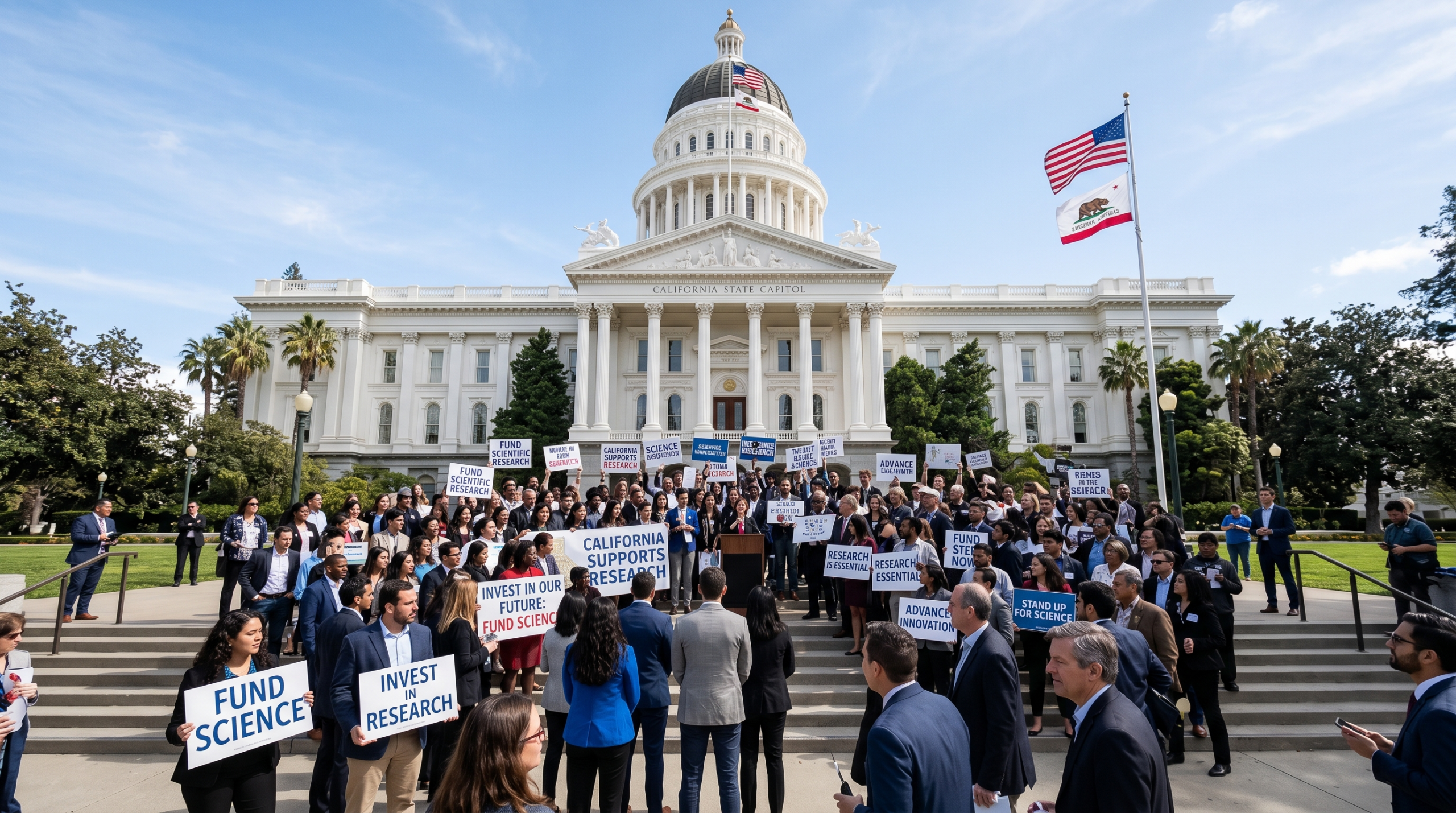
California state legislators and scientific advocates gathered at the State Capitol in Sacramento on Monday to champion a proposed $23 billion bond measure aimed at sustaining scientific research funding in response to significant federal budget reductions.
The proposed legislation, Senate Bill 895, known as the California Science and Health Research Bond Act, would place the funding question before California voters in the upcoming November election. The measure seeks to issue bonds to finance research across multiple scientific disciplines at a time when federal support faces unprecedented reductions.
State Senator Scott Wiener, a Democrat from San Francisco who authored the bill, emphasized California’s commitment to scientific advancement despite federal cutbacks. The measure has garnered substantial legislative support, with approximately one-third of California’s Legislature listed as co-authors.
The urgency surrounding the bill stems from the Trump administration’s congressional budget request, which proposes eliminating billions in federal research spending. Among the most significant cuts is a 12 percent reduction to the National Institutes of Health budget, representing approximately $6 billion in lost funding.
Ryan Manriquez, a spinal muscular atrophy survivor who spoke at Monday’s rally, shared his personal story to illustrate the life-saving importance of scientific research. Born in 2000 when SMA was a leading cause of infant mortality, Manriquez credits scientific breakthroughs with his survival. The first treatment for his condition received federal approval in 2016, enabling him to attend college and serve with AmeriCorps.
Dr. Monica Gandhi, a clinical medicine professor at UCSF, emphasized the National Institutes of Health’s critical role in medical breakthroughs, citing the transformation of HIV from a fatal diagnosis to a manageable condition through research-funded developments.
The proposed funding cuts have already impacted California’s research community. Cheyenne Dean, a former research associate, reported losing her position last year due to budget reductions. She expressed concern that remaining staff face increased workloads with reduced compensation.
Dr. Stuart Bussey, president of the Union of American Physicians and Dentists, warned that tens of thousands of jobs hang in the balance. He characterized Senate Bill 895 as a necessary long-term financial commitment to protect scientific independence from political pressures.
The issue gained additional attention following the Trump administration’s decision to withdraw billions in grant funding from Harvard University last year after the institution declined to implement certain admission and hiring modifications.
Jessica Taft, co-president of the Council of UC Faculty Associations, stressed the collective effort needed to preserve scientific research funding, while United Auto Workers president Shawn Fain framed the issue as a matter of public priorities, advocating for research investment over other expenditures.
The bill currently awaits consideration in the Senate Appropriations Committee, facing a critical deadline next week alongside hundreds of other legislative proposals. If approved by the legislature, California voters will ultimately determine whether to approve the $23 billion bond measure in November’s general election.
The proposed funding represents California’s attempt to maintain its position as a scientific research leader while offsetting federal budget reductions that advocates argue could significantly impact medical breakthroughs and scientific employment across the state.
Leave a Reply