
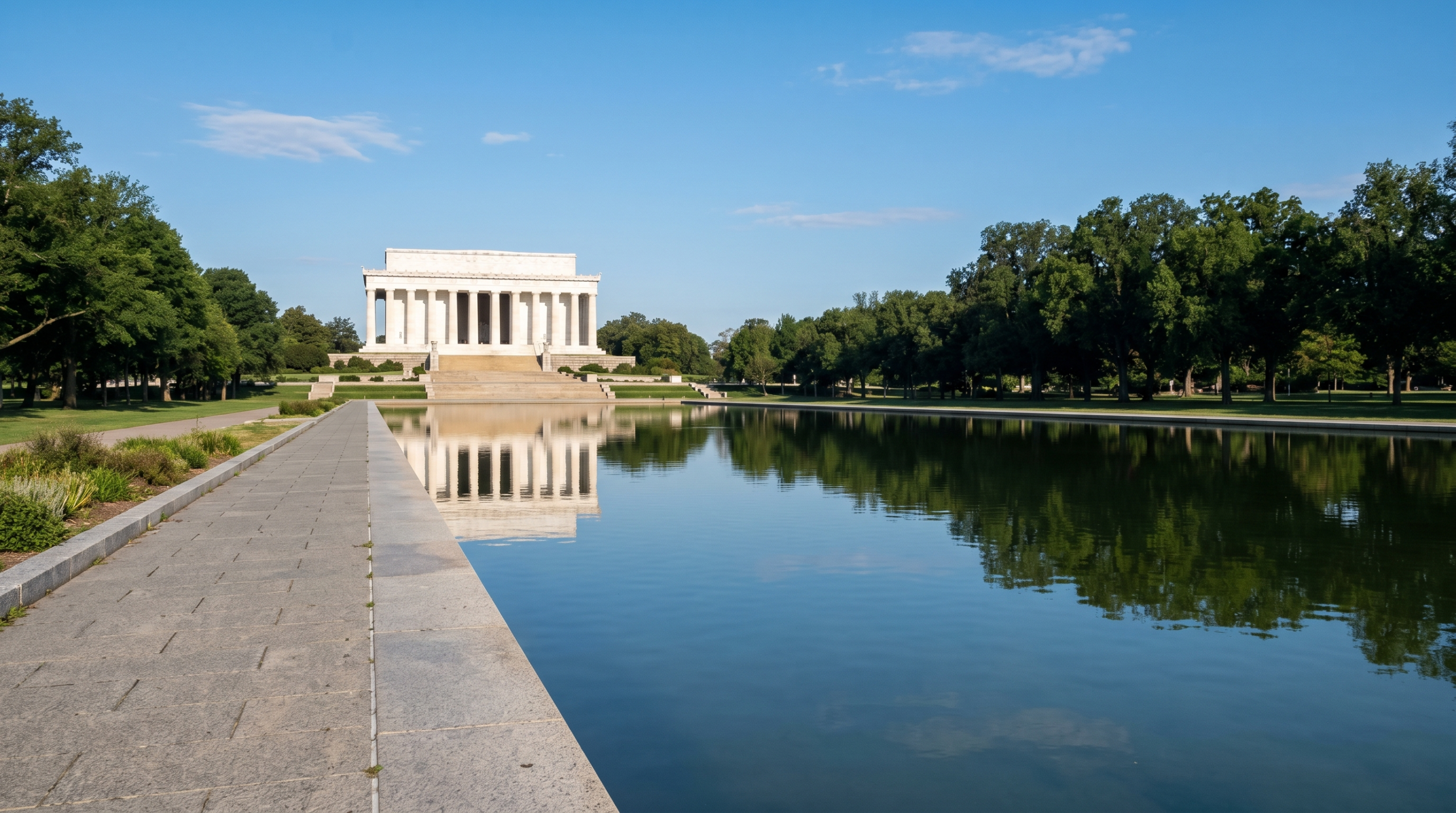
A federal judge indicated Thursday that a controversial project to repaint the Lincoln Memorial Reflecting Pool from its traditional dark gray to “American flag” blue will likely proceed despite legal challenges from preservationists.
U.S. District Judge Carl Nichols expressed skepticism during a hearing about granting an immediate injunction to halt the $6.9 million project, which President Donald Trump announced on April 23 with a completion deadline coinciding with the nation’s 250th anniversary celebrations.
The Cultural Landscape Foundation filed suit seeking to freeze the project, arguing the government improperly bypassed congressional notice requirements and mandatory review processes for such alterations to historic landmarks. The nonprofit organization contends the change would damage the “historic character” of the 104-year-old reflecting pool, marking its first color change since construction in 1922.
During Thursday’s hearing, Judge Nichols, who was appointed by Trump, pressed the foundation’s attorneys Alexander Kristofcak and Joseph Mead to explain why aesthetic concerns warranted immediate judicial intervention. Mead argued the epoxy primer material planned for the pool floor is intended to be permanent and would fundamentally alter the landmark’s appearance for an extended period.
The president awarded the contract without competitive bidding to Atlantic Industrial Coatings, a company that has completed work at Trump National Golf Club in Sterling, Virginia. To bypass standard procurement procedures, the administration cited an exemption reserved for urgent situations preventing serious injury to government interests, pointing solely to the upcoming Independence Day celebrations.
Justice Department attorney John Heise defended the project, noting the pool’s primary function is reflecting the Washington Monument and Lincoln Memorial, questioning whether the color difference between gray and blue would substantially impact this purpose. He suggested any aesthetic harm claimed by the foundation did not rise to the level requiring immediate court action.
The judge explored whether the epoxy coating could be reversed if necessary. Heise confirmed the material could not be removed but could be repainted, prompting Nichols to suggest he might later order restoration to the pool’s 2012 appearance when it last underwent significant improvements.
Trump stated publicly that the blue color would make the reflecting pool “much better than it ever was.” The administration has positioned the repainting as part of necessary maintenance, though the current project does not address underlying structural problems with the pool’s filtration system that create annual algae buildup.
The reflecting pool controversy represents one element of Trump’s broader effort to reshape Washington’s architectural landscape. Other initiatives include demolishing the East Wing for ballroom construction, proposing to tear down the Kennedy Center, and planning a 250-foot “Independence Arch.” Senior U.S. District Judge Richard Leon has already blocked the ballroom project while allowing underground bunker construction to proceed, ruling the president lacked congressional approval. That decision is now under appellate review.
The Commission of Fine Arts, composed primarily of Trump appointees, voted Thursday to approve the arch designs. The National Capital Planning Commission has scheduled its design review for June 4.
As arguments concluded, the foundation’s attorney Mead maintained that any disruption to the July 4 celebrations resulted from the government’s decision to initiate the project without proper procedures, not from legal challenges seeking to preserve the landmark’s historic integrity.
Leave a Reply