
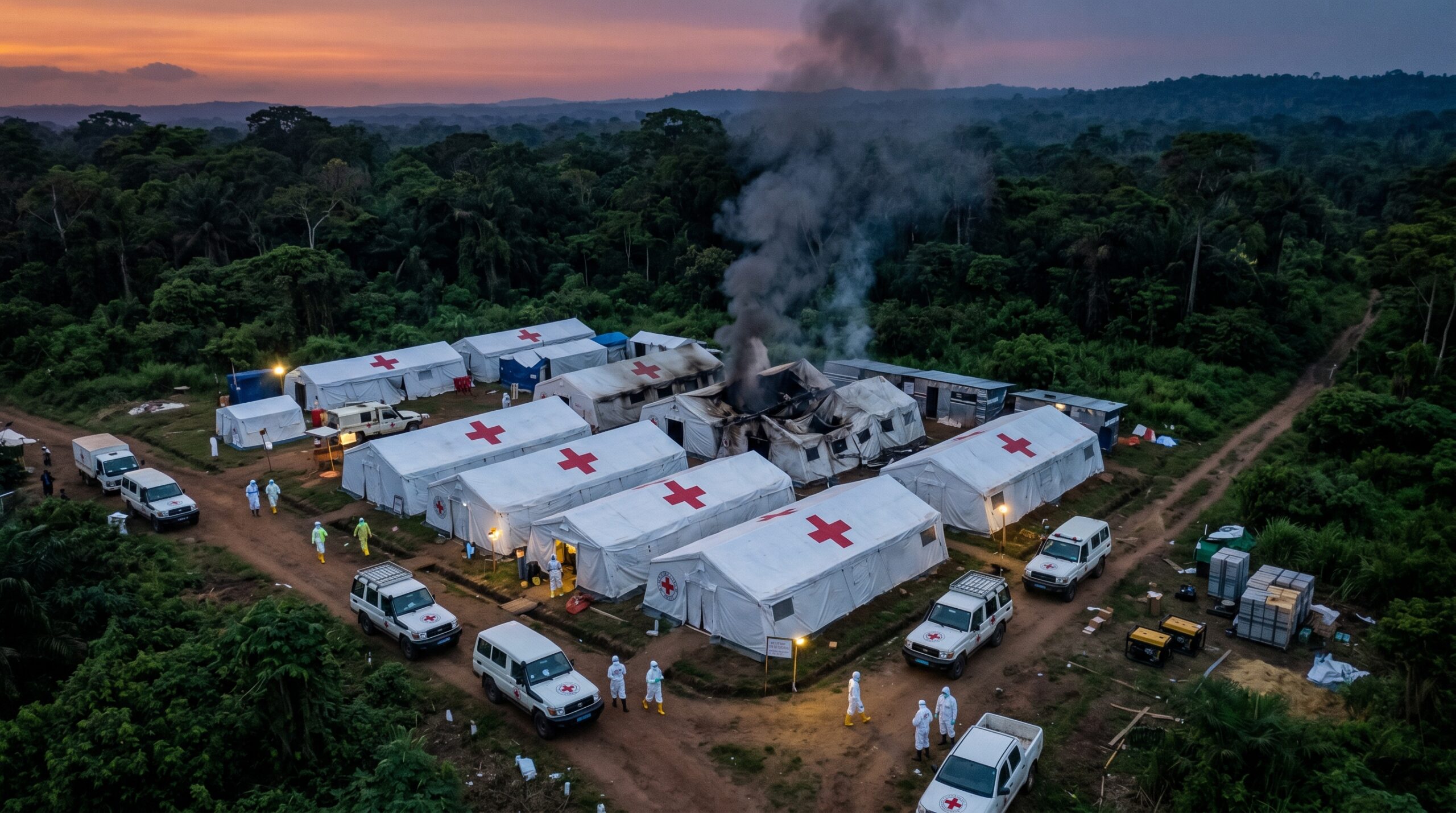
A medical treatment center in Mongbwalu, eastern Congo, was attacked and partially destroyed by angry residents on Friday night, resulting in 18 suspected Ebola patients fleeing the facility and remaining unaccounted for. The incident marks the second assault on a healthcare facility in the region within a week, highlighting growing tensions between local communities and health authorities responding to the outbreak.
The attackers targeted and set fire to a tent structure that had been established for treating suspected and confirmed Ebola cases. The facility was operated by the international medical organization Doctors Without Borders. While initial reports indicate no injuries occurred during the attack, the fire created panic among medical staff and patients alike.
Dr. Richard Lokudi, director of Mongbwalu hospital, expressed serious concern about the incident and its consequences. He emphasized that the escape of 18 suspected cases into the surrounding community poses significant public health risks and complicates containment efforts.
The attack followed a similar incident on Thursday in the town of Rwampara, where another treatment center was burned down. That assault occurred after authorities prevented family members from retrieving the body of a local resident suspected to have died from Ebola. The handling of deceased victims has become a particularly sensitive issue, as bodies of Ebola victims can be highly contagious and traditional burial practices may contribute to disease transmission.
On Saturday, communal burials for Ebola victims in Rwampara proceeded under heavy security presence. Armed soldiers and police officers monitored the proceedings as Red Cross workers in protective equipment lowered sealed coffins into the ground. Family members were required to maintain distance during the ceremony. David Basima, a Red Cross team leader overseeing burials, reported significant resistance from young people and community members, necessitating security intervention.
The World Health Organization has elevated the outbreak risk assessment for Congo from “high” to “very high,” though global spread risk remains low. WHO Director-General Tedros Adhanom Ghebreyesus reported 82 confirmed cases and seven deaths, while acknowledging the actual scale may be substantially larger. Current surveillance data indicates 750 suspected cases and 177 suspected deaths, with numbers expected to rise as monitoring expands.
The outbreak involves the Bundibugyo virus, a rare Ebola variant for which no vaccine currently exists. The virus spread undetected for weeks in Ituri province while authorities tested for more common Ebola strains, receiving negative results.
Three Red Cross volunteers have died from the outbreak in Mongbwalu. The organization believes these healthcare workers contracted the virus on March 27 while handling deceased individuals during humanitarian work unrelated to Ebola response. If confirmed, this would significantly alter the outbreak timeline, predating the previously identified first death in late April in Bunia, Ituri’s capital.
In response to the outbreak, northeastern Congo authorities have implemented restrictions banning funeral wakes and gatherings exceeding 50 people. Dr. Jean Kaseya of the Africa Centers for Disease Control and Prevention stressed that effective outbreak response requires building community trust.
The United States has announced travel restrictions affecting green card holders who have recently visited affected regions. The federal health authorities are prohibiting permanent residents who have been in Congo, Uganda, or South Sudan from returning to the United States. The inclusion of South Sudan remains unclear, as no Ebola cases have been confirmed there during this outbreak. Officials stated these measures aim to ensure adequate screening, contact tracing, and medical monitoring capabilities for U.S. citizens.
Leave a Reply