
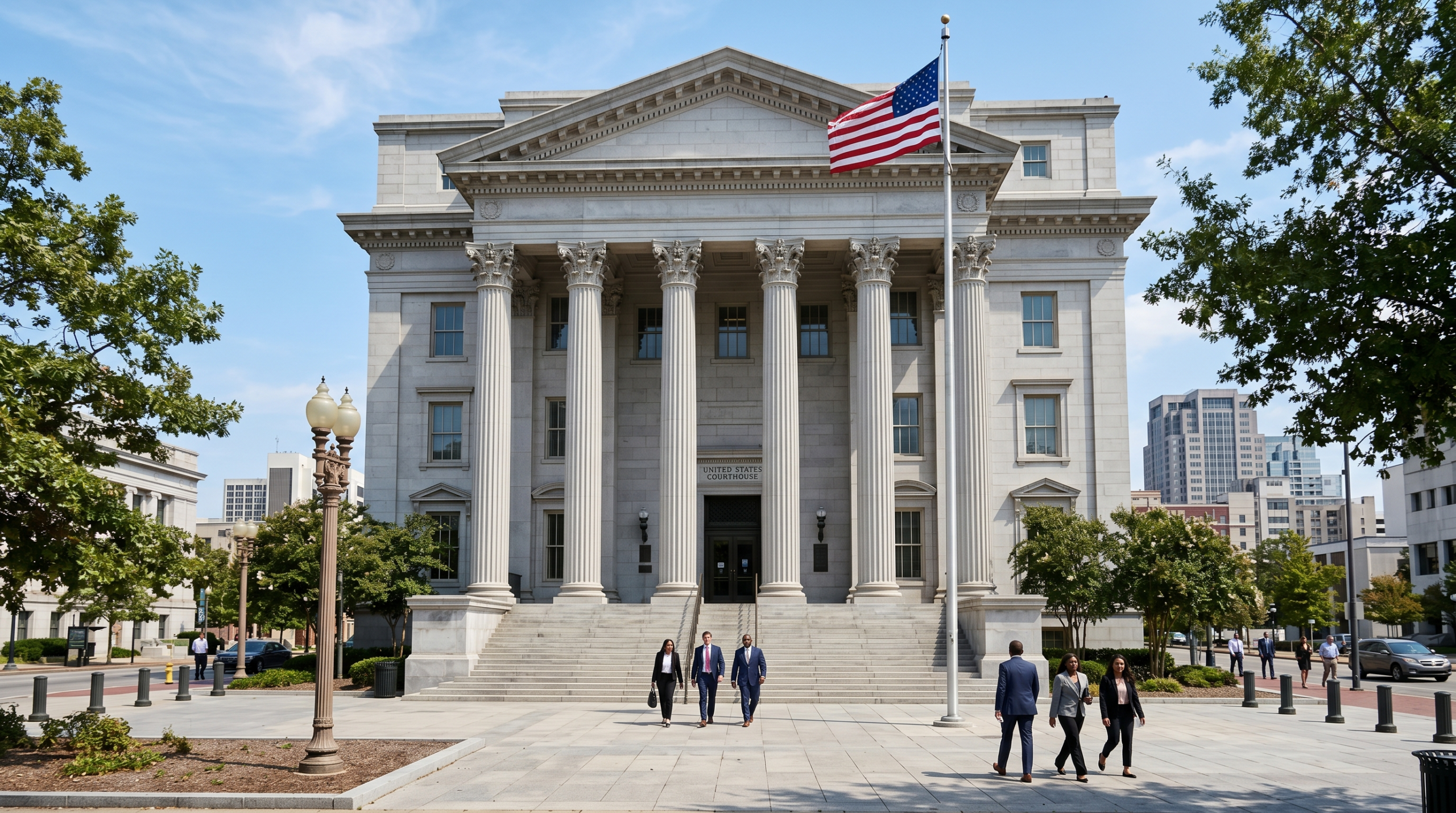
A critical legal battle over Alabama’s congressional district boundaries reached federal court on Friday, with voter advocacy groups fighting to maintain maps that provide Black voters with meaningful electoral representation in two of the state’s seven congressional districts.
The case, heard at the Northern District of Alabama in Birmingham, centers on whether the state should continue using a court-ordered remedial map or revert to a 2023 legislative map that was previously declared unconstitutional. The timing adds urgency to the proceedings, with the May 27 deadline for voter reassignment approaching and absentee ballots due June 2.
The dispute gained new complexity following the Supreme Court’s recent Louisiana vs. Callais decision, which established stricter standards for challenging voting maps based on racial discrimination claims under the Voting Rights Act. Republican state lawmakers have seized on this ruling to advocate returning to their 2023 map configuration.
State Director of Elections Jeff Elrod testified extensively about the practical challenges of implementing either map. He acknowledged that switching to the 2023 legislative map would create significant logistical hurdles, particularly in Jefferson, Elmore, and Covington counties where district boundaries would shift. Despite previously declaring that map changes would require three to four months, Elrod suggested Friday that aggressive timelines and overtime work could compress the process to approximately one week.
The current remedial map, drawn by a special master and used in three elections including the May 19 primary, created a second Black-majority district. This configuration enabled the 2024 election of Congressman Shomari Figures, a Black Democrat representing the newly drawn district.
Attorney Abha Khanna, representing the plaintiff voters, argued that Alabama’s 2023 congressional plan continues to violate Section 2 of the Voting Rights Act, even under the heightened Callais standard. She emphasized the extensive record already established regarding Alabama’s history of racially polarized voting patterns and discriminatory redistricting practices.
Alabama Solicitor General Barrett Bowdre countered that the Callais decision fundamentally altered the legal landscape, requiring the court to reevaluate its previous findings under the new framework. He questioned whether the plaintiffs’ expert witnesses, including mathematician Moon Duchin, had improperly considered race in their analysis of district configurations.
Bowdre highlighted the challenge of separating racial and political considerations in Alabama, noting that the majority of Black Alabamians vote Democratic while most white Alabamians support Republicans. He argued that explicitly checking whether districts achieve Black majorities violates the Callais standard.
Elrod’s testimony revealed additional concerns about voter confusion and electoral integrity. He admitted that previous map changes had eroded public confidence in the election process and could discourage voter participation. When pressed about the feasibility of rapid implementation, Elrod expressed uncertainty about whether local election officials could meet the compressed timeline, acknowledging he had not consulted individual counties about their capacity.
The three-judge panel hearing the case consists of U.S. Circuit Judge Stanley Marcus, appointed by Bill Clinton, and U.S. District Judges Anna Manasco and Terry Moorer, both appointed by Donald Trump. Their questioning focused on understanding how the Callais decision altered the legal analysis and testing the evidence and practical considerations presented by both sides.
The judges gave no indication of when they would issue their ruling, leaving election officials and candidates in limbo as critical deadlines approach. The decision will determine not only which map governs upcoming elections but also potentially reshape the balance of political representation for Alabama’s Black voters.
Leave a Reply