
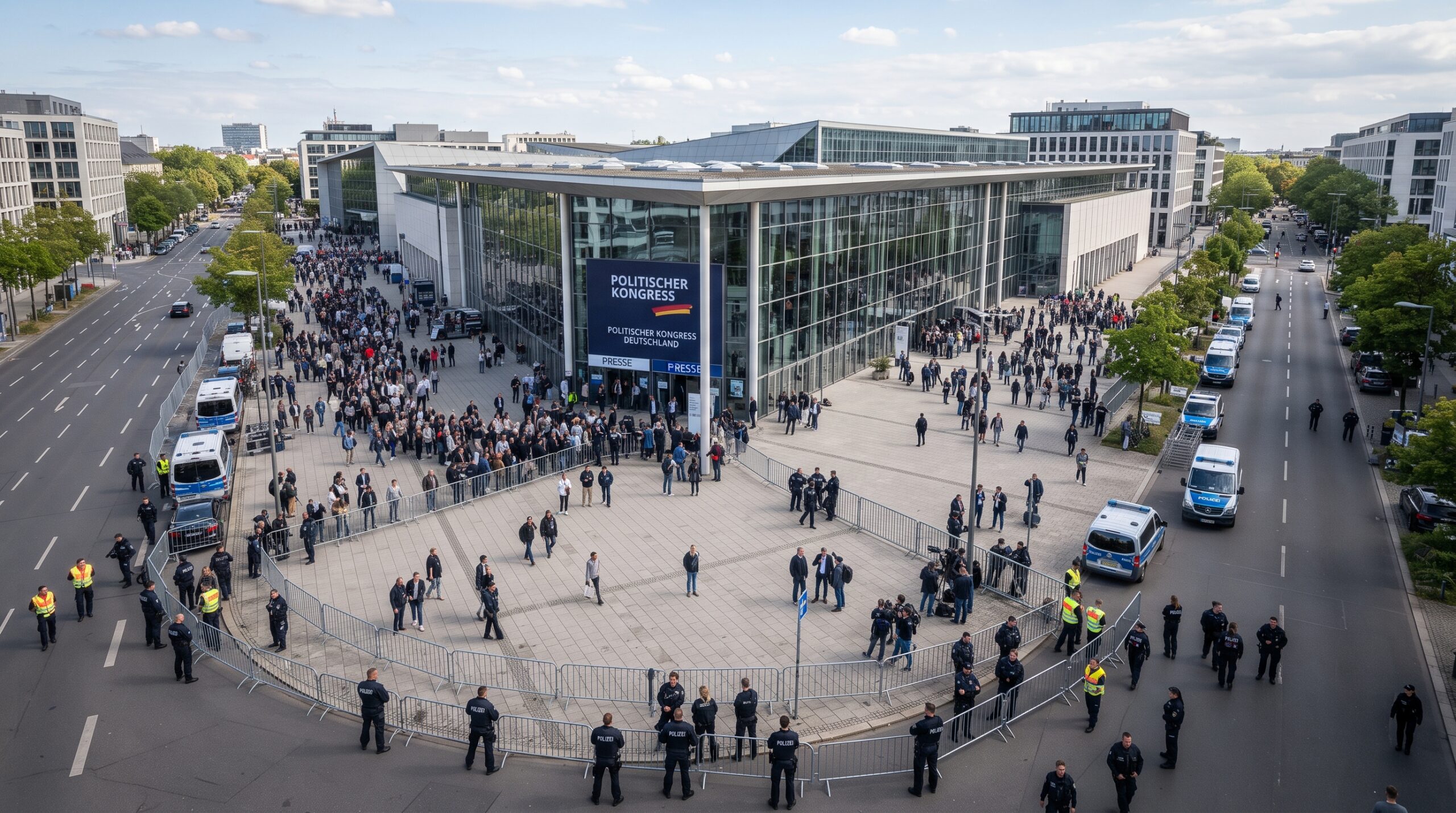
Germany’s far-right Alternative for Germany party is experiencing significant political momentum as it prepares for crucial regional elections this fall, potentially positioning itself to lead a state government for the first time in its history.
The party, known as AfD, is convening in the eastern city of Erfurt this weekend for its biennial leadership election. Alice Weidel and Tino Chrupalla, who have jointly led the party for four years, are expected to have their terms extended as the organization seeks to project unity ahead of key electoral contests.
In last year’s national elections, AfD secured 20.8 percent of the vote, marking the strongest performance by a far-right party in Germany since World War II. The result positioned AfD as the largest opposition party nationally and the dominant political force in eastern Germany. Recent polling suggests the party’s support has continued to grow, with some assessments placing it in first position nationwide.
The party is particularly focused on the September 6 state election in Saxony-Anhalt, where it hopes to capture 40 percent or more of the vote. Such a result could potentially deliver an absolute majority or create conditions where the party might attract defectors from other political groups, opening a path to its first state governorship. Another opportunity follows two weeks later in Mecklenburg-Western Pomerania.
Political analyst Albrecht von Lucke, who edits the magazine Blätter für deutsche und internationale Politik, noted that AfD is standing before the gates of power to some extent. The party achieved its first county administration leadership in 2023 in Thuringia, though no additional victories at that level have followed.
State governance would represent a significantly larger achievement. Germany’s 16 states maintain substantial autonomy, including control over education systems and security matters. Critics have expressed concerns about the prospect of AfD replacing civil servants en masse and the potential security implications of confidential information reaching far-right networks.
Gregor Maier, Thuringia’s center-left interior minister, warned that an AfD interior minister would constitute a security risk. The party dismisses such concerns, with Chrupalla asserting at a recent Berlin rally that AfD will demonstrate superior governance capabilities.
The party’s rise has been facilitated by widespread dissatisfaction with Chancellor Friedrich Merz’s coalition government, which assumed power 14 months ago promising economic reforms. Despite embarking on significant changes to address economic stagnation, the government has struggled to convince voters of its effectiveness.
Beyond its traditional focus on immigration restrictions, AfD has expanded its appeal by addressing various contentious issues. The party has expressed support for the Trump administration’s general approach, criticized military involvement in Iran, advocated for lifting sanctions against Russia, and opposed weapons deliveries to Ukraine.
AfD remains under scrutiny from Germany’s domestic intelligence agency, the Federal Office for the Protection of the Constitution, which classified it as a proven right-wing extremist group before suspending the designation following a legal challenge. A Cologne court ruled in February that the agency cannot use this designation while considering the party’s lawsuit.
The intelligence agency’s 2025 report indicated no evidence that the party had moderated its controversial positions, citing statements reflecting an ethnicity-based understanding of nationhood that contradicts Germany’s constitutional principles. The report highlighted calls for mass remigration and references to an alleged great replacement of the population.
AfD strongly refutes extremism accusations and maintains that the intelligence agency is being utilized by mainstream parties as a political weapon. The party’s convention is expected to attract tens of thousands of protesters to Erfurt, many likely calling for the party to be banned, though Germany’s supreme court has historically set extremely high barriers for party prohibitions.
Leave a Reply