
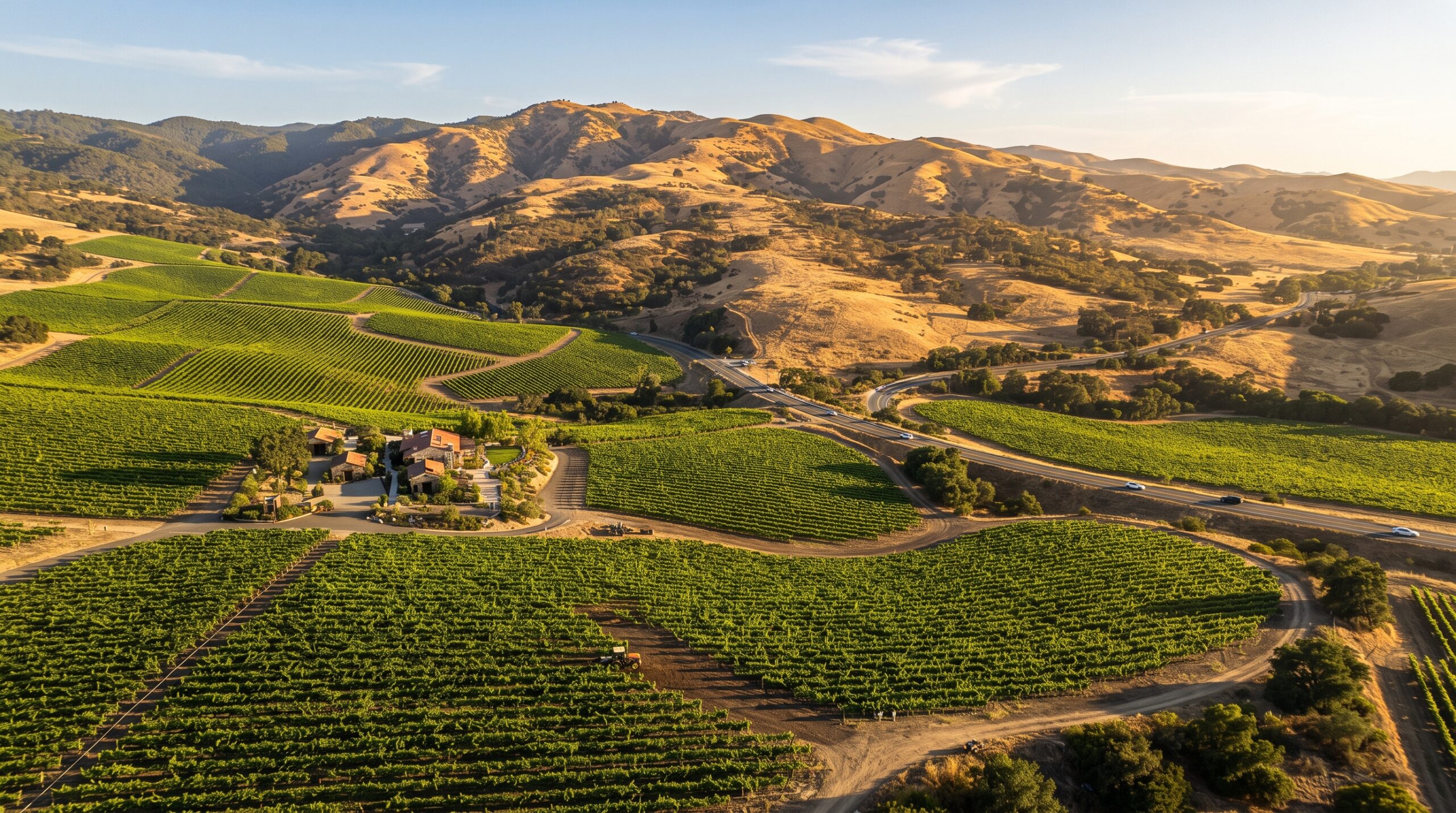
California’s celebrated wine regions may undergo significant transformation over the coming decades as changing climate patterns reshape the agricultural landscape, according to new research examining the future of grape cultivation across the state.
The study, published in Frontiers in Climate, analyzed nearly 400 locations throughout California, focusing primarily on the North Coast and Central Coast regions. Researchers utilized machine learning algorithms and climate modeling to project how environmental conditions might affect wine production through the end of the century.
The findings suggest that traditional wine-producing counties including Napa, Sonoma, San Luis Obispo, and Santa Barbara could experience declining conditions for grape cultivation under severe climate change scenarios. Meanwhile, certain areas in Northern California and along the coast, particularly Mendocino and Monterey counties, show promise for enhanced wine production capabilities.
Yusuke Hiraga, a researcher at Tohoku University in Sendai, Japan, who co-authored the study, highlighted the unique advantages these emerging regions might possess. The research indicates these areas could benefit from both improving climatic conditions for viticulture and a reduction in extreme fire-weather days, a combination that distinguishes them from other regions facing either increased wildfire risks or declining agricultural suitability.
The research team employed sophisticated modeling techniques, creating projections based on a 4-kilometer-by-4-kilometer grid across the mainland United States. They examined two different carbon emission scenarios: one assuming gradual implementation of climate mitigation policies and another representing worst-case conditions. The analysis covered three distinct time periods: 1976-2005 as a baseline, 2040-2069 for midcentury projections, and 2070-2099 for late-century forecasts.
Key factors determining wine production suitability included annual precipitation levels, temperatures during growing seasons, coldest month temperatures, and vapor pressure deficit—a measurement indicating atmospheric moisture absorption capacity. The machine learning algorithm used in the study was trained on professional wine ratings from Wine Spectator magazine spanning from 1996 to 2023.
Despite challenges facing some established regions, the research identified potential bright spots. Sonoma Chardonnay, for instance, showed promise for improved quality under future climate conditions. Additionally, while many areas across California face increased wildfire risk, particularly in northern and high-elevation regions, Mendocino and Monterey counties demonstrated decreasing trends in extreme fire-weather days.
For wine producers and viticulturists, adaptation strategies will become increasingly important. Hiraga emphasized that shifting to different grape varieties represents one of the most effective approaches, as climate impacts vary significantly between varietals. Adjusting harvest timing could also help producers adapt without requiring dramatic changes to their operations. These strategies remain viable even in warmer regions like Temecula.
The implications extend beyond California’s borders. California currently produces approximately 80 percent of United States wine output and ranks as the world’s fourth-largest wine producer, following Spain, France, and Italy. Similar research conducted by Hiraga’s team in Japan revealed comparable patterns, with traditional wine regions like the Kofu Basin facing potential decline while northern prefectures show increasing hospitality to viticulture.
The study’s authors caution that predicting exact timelines for when emerging regions might surpass established wine areas remains complex. The future of viticulture depends not only on climate and wildfire patterns but also on numerous human factors and management decisions.
Lower greenhouse gas emission scenarios consistently showed better outcomes for wine quality preservation through the century’s end, underscoring the potential benefits of climate mitigation efforts for the industry’s future.
Leave a Reply