
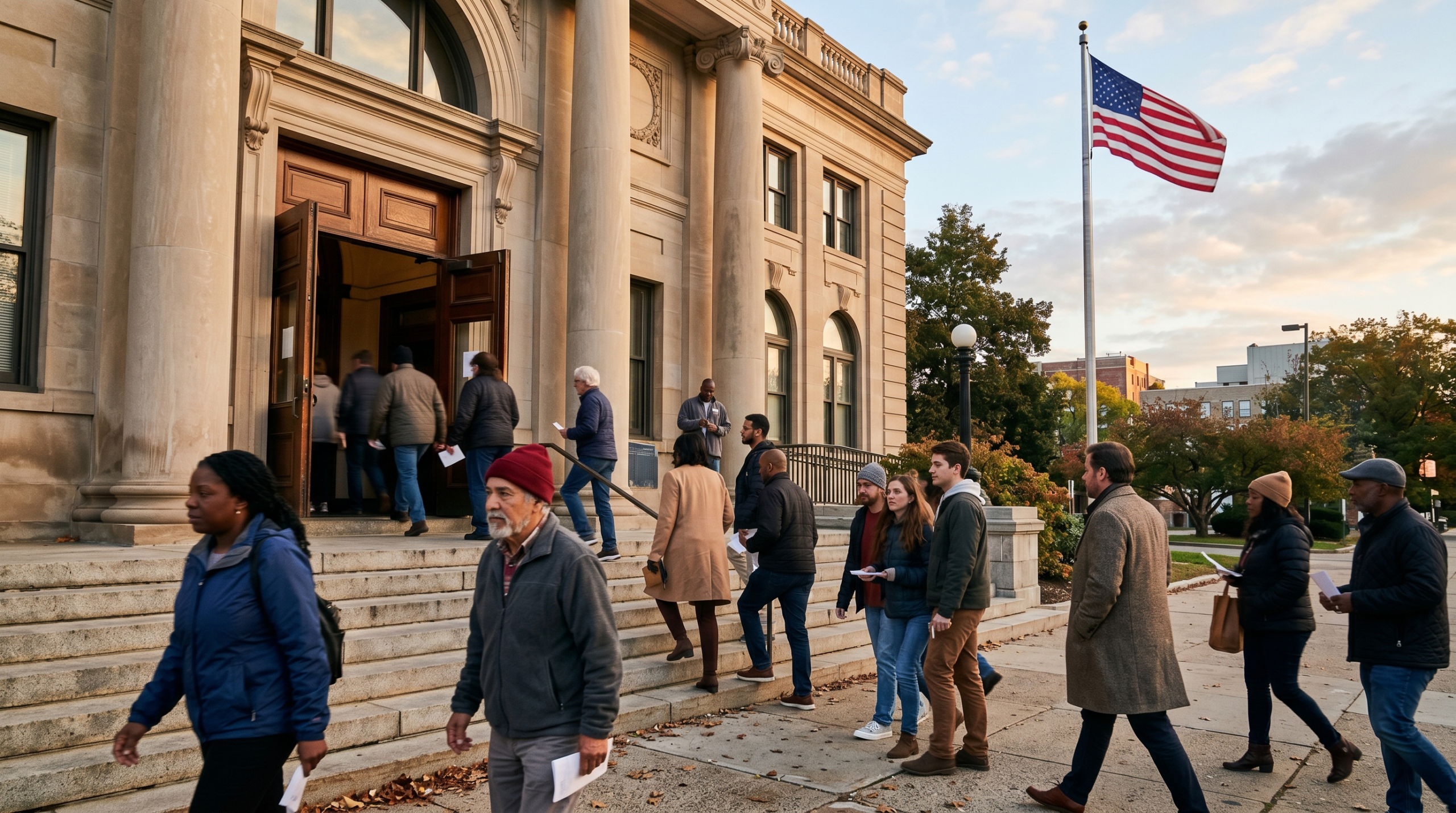
Virginia voters have approved a controversial constitutional amendment that will allow the state legislature to redraw congressional district boundaries ahead of the November midterm elections. The measure passed with 50.7% support, receiving 1,374,544 votes in favor and 1,336,737 against, according to the Virginia Department of Elections.
The amendment, which Democratic legislators fast-tracked through a special session in October, contains trigger language permitting Virginia to modify its congressional districts if another state alters its districts for reasons other than court orders. The change is expected to shift Virginia’s congressional delegation from six Democratic and five Republican seats to ten Democratic and one Republican seat.
Democratic Governor Abigail Spanberger celebrated the victory, stating that Virginia voters had approved a temporary measure to address what she characterized as demands for more Republican congressional seats nationwide. The governor emphasized that Virginians had responded appropriately through the democratic process at the ballot box.
The referendum attracted unprecedented financial attention, with nearly $100 million spent by competing campaigns. Virginia for Fair Elections, the group supporting the measure, invested $64 million, while opponents through Virginia for Fair Map contributed approximately $20 million. These funds fueled extensive television and internet advertising campaigns featuring prominent political figures on both sides.
Republican House minority leader Terry Kilgore acknowledged the defeat while criticizing what he described as misleading ballot language and a significant spending disadvantage. The ballot question asked voters whether the state constitution should be amended to allow temporary adoption of new congressional districts to restore fairness in upcoming elections while ensuring standard redistricting processes resume after the 2030 census.
Legal challenges to the amendment remain pending before the Supreme Court of Virginia. The high court previously allowed the referendum to proceed while awaiting briefs due on April 23. Two separate lawsuits filed by Republican leaders and the National Republican Congressional Committee have challenged both the procedural legitimacy of the amendment process and the clarity of the ballot language.
A local judge in Tazewell had twice ruled in favor of Republicans seeking to halt the referendum, but these decisions were superseded by the state Supreme Court’s decision to allow the vote to proceed. The legal questions surrounding the amendment’s validity and the process used to place it before voters remain unresolved.
The redistricting effort comes six years after Virginia voters overwhelmingly approved a constitutional amendment designed to prevent partisan gerrymandering. The current congressional map was drawn by the Supreme Court of Virginia following that reform.
Democratic Speaker of the House of Delegates Don Scott characterized the vote as changing the trajectory of the 2026 midterm elections, suggesting Virginia had leveled the playing field nationally. The proposed new map would redistribute portions of Northern Virginia, a densely populated liberal-leaning region, across multiple districts throughout the state, leaving only one safely Republican district in the southwestern portion of Virginia.
Six states, including Texas and California, have already implemented new congressional maps during this cycle. Maryland’s legislature failed to pass a similar redistricting amendment through its state Senate, while the Supreme Court blocked attempts to redraw a Republican congressional district in New York in March.
The referendum’s passage reflects Virginia’s recent political shift, following the 2025 elections where Democrats gained control of the governor’s mansion, the attorney general’s office, and secured a 64-to-36 advantage in the House of Delegates after flipping thirteen seats.
Leave a Reply