
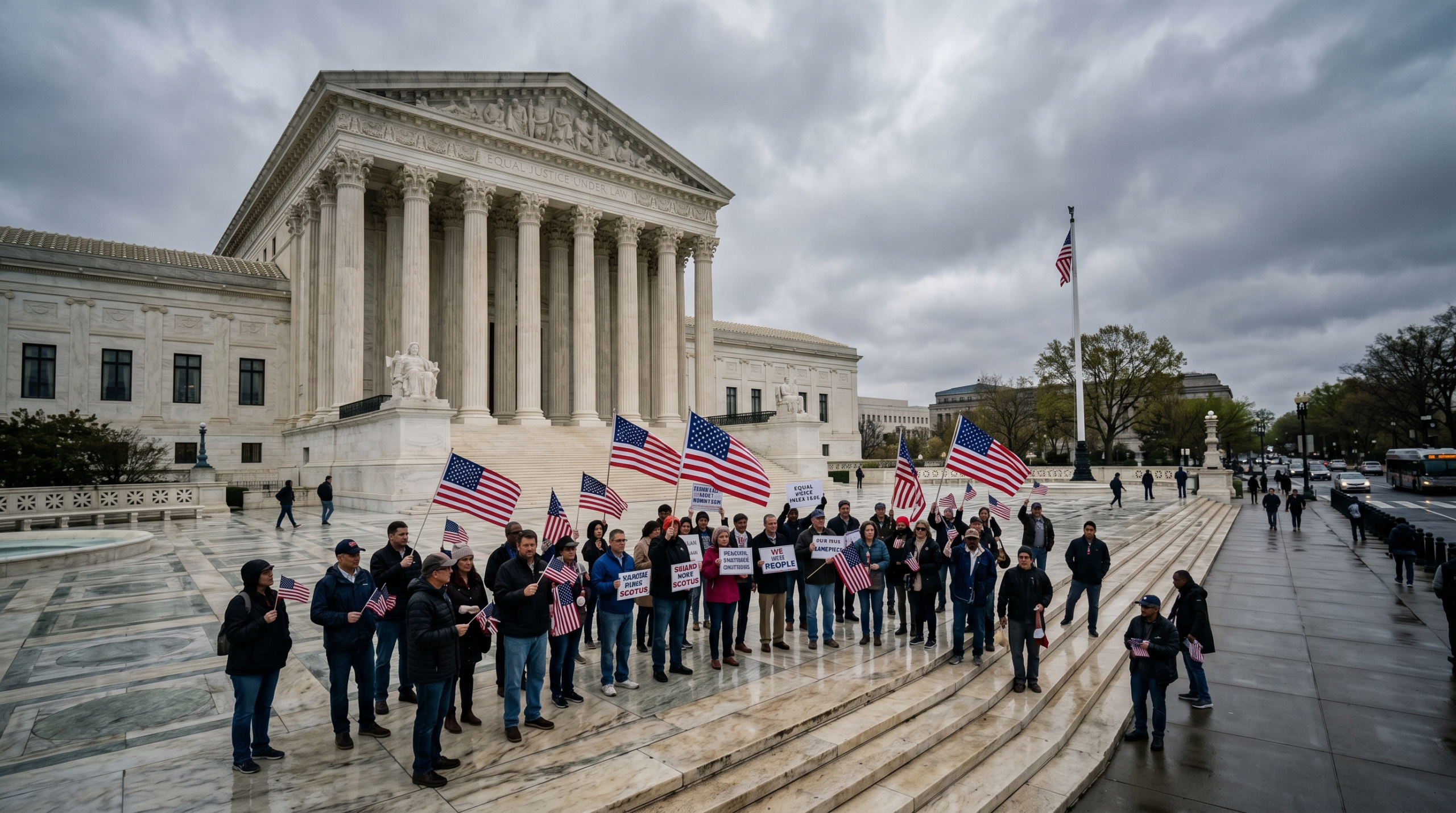
The future of hundreds of thousands of migrants with temporary protected status hung in the balance Wednesday as the Supreme Court heard arguments over the administration’s authority to revoke protections for Haitian and Syrian nationals.
Outside the courthouse, musicians from Los Jornaleros del Norte performed while advocates from the National TPS Alliance rallied in support of migrants who could face deportation if the court sides with the government. Inside, justices grappled with complex questions about judicial review and executive power.
The case centers on whether courts can review the procedural steps leading to termination of temporary protected status, a designation that shields nationals from certain countries from deportation when their homelands face armed conflict, natural disasters, or extraordinary conditions. The Immigration and Nationality Act contains language barring judicial review of TPS determinations, creating a significant legal hurdle for challengers.
Conservative justices expressed concern about opening the door to widespread procedural challenges. Justice Samuel Alito warned that departing from the ordinary meaning of the review bar would enable constant procedural objections to administrative decisions. Justice Amy Coney Barrett questioned whether allowing procedural review would accomplish much if the administration could still terminate protections by following proper steps.
Liberal justices raised questions about discriminatory intent behind the terminations. Justice Sonia Sotomayor cited presidential statements describing Haiti using derogatory terms and expressing preference for immigrants from predominantly white European nations. Justice Ketanji Brown Jackson referenced claims about migrants “poisoning the blood of Americans.”
Solicitor General John Sauer defended the administration’s position, characterizing controversial statements as commentary on poverty and crime rather than race. He maintained that such remarks were not relevant to the legal inquiry at hand.
Syrian nationals first received protected status in 2012 during the Assad regime’s violent crackdown. Former Homeland Security Secretary Kristi Noem announced termination of Syrian protections in September 2024, citing the overthrow of Bashar Assad and new diplomatic efforts. The administration argued that ongoing conflicts no longer posed serious threats to the approximately 6,100 Syrian nationals with protected status.
Haiti’s designation dates to 2010 following a devastating earthquake, with extensions granted due to persistent instability. Despite United Nations warnings about escalating gang violence and humanitarian crisis, with murder rates rising nearly 20 percent and 5.7 million Haitians facing food insecurity, Noem revoked protections for over 350,000 Haitian nationals in 2025.
Both countries remain under the State Department’s highest risk advisories, warning against all travel due to terrorism, crime, kidnapping, and armed conflict. Haiti’s advisory additionally notes limited healthcare access.
Lower courts had blocked both terminations, prompting emergency appeals to the Supreme Court. The justices deferred immediate action on the administration’s applications, temporarily preserving the migrants’ protected status while considering the broader legal questions.
The stakes extend far beyond Haiti and Syria. Nearly 1.5 million people currently hold temporary protected status from various countries. A ruling favoring the government could enable termination of protections for additional nations without judicial oversight. Conversely, a decision allowing judicial review would send the cases back to lower courts for examination on the merits.
After nearly two hours of arguments, the court’s direction remained unclear. The justices must balance executive authority over immigration policy against concerns about arbitrary or discriminatory enforcement, with profound implications for migrants who have built lives in the United States under temporary protections.
Leave a Reply