
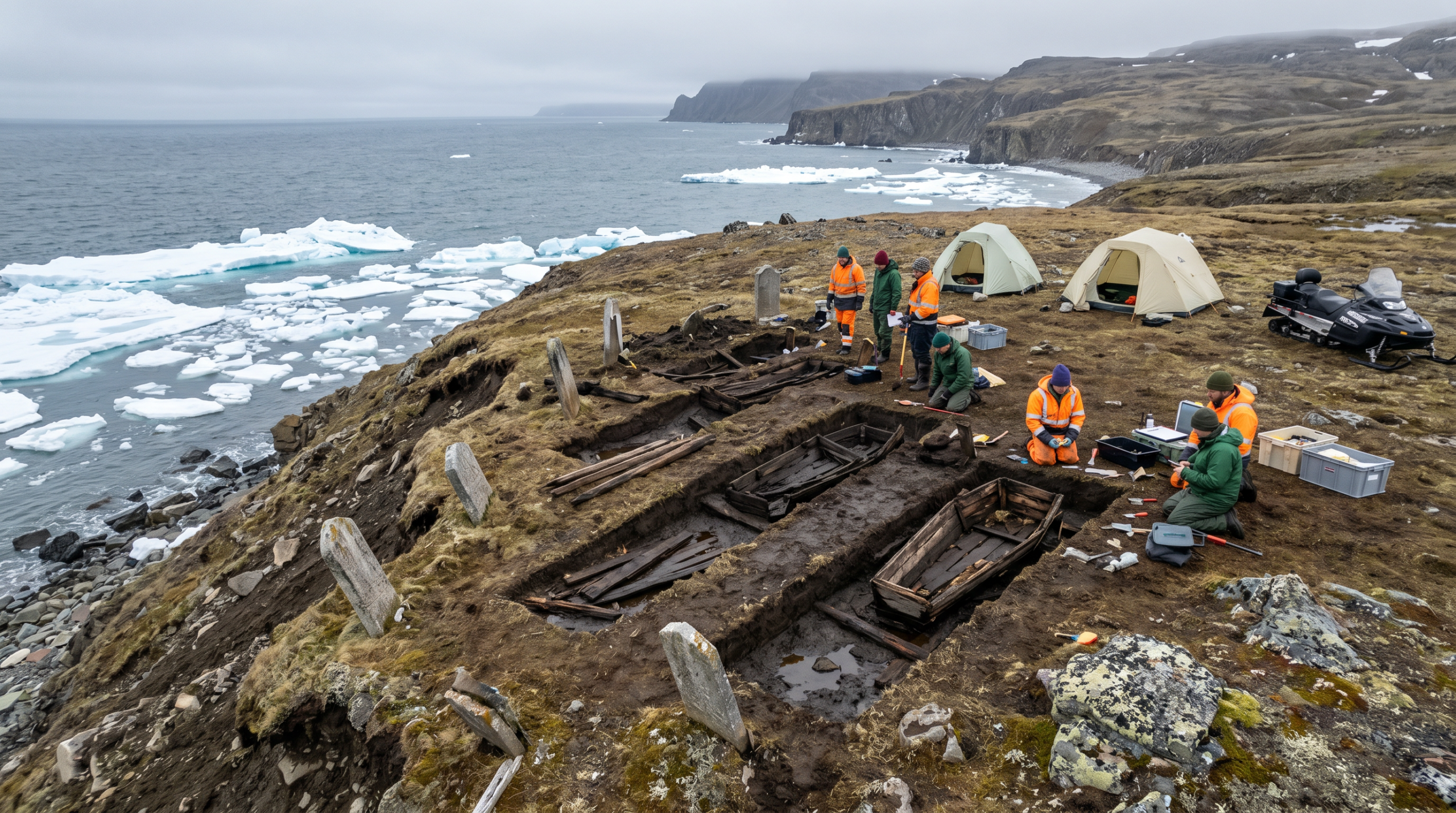
Important archaeological sites across the Arctic region are experiencing unprecedented deterioration as rising temperatures cause permafrost to thaw, threatening valuable historical and scientific data preserved for centuries in frozen ground.
Recent research has documented significant degradation at cultural heritage locations, including a 17th-century burial ground in Likneset on Svalbard, a Norwegian archipelago situated near the North Pole. The site, which contains over 200 graves from Europe’s early whaling industry, demonstrates the accelerating impact of climate change on Arctic archaeological preservation.
Lise Loktu, an Arctic archaeologist at the Norwegian Institute for Cultural Heritage Research who co-authored research published in PLOS One, explained that the deterioration affects both the physical structure of sites and the materials preserved within them. The permafrost layer, which can reach depths of 30 meters near coastal areas, has historically protected these remains from decay.
As frozen ground becomes increasingly unstable, burial contexts experience multiple forms of degradation. Physical changes include ground cracking, sinking, and sediment displacement. At coastal locations like Likneset, erosion and diminished sea ice protection intensify these effects, resulting in collapsed coffins, shifting stone grave structures, and compromised burial layer integrity. In extreme cases, entire graves have been partially or completely destroyed as sediments wash into the sea.
The thawing process introduces moisture and oxygen into previously sealed burial environments, dramatically increasing microbial activity. This accelerates the decomposition of organic materials including wood, leather, textiles, hair, skin, and bone surfaces. Different materials deteriorate at varying rates, with textiles showing particularly severe degradation between excavations conducted in the 1980s and more recent work in 2016.
The human remains themselves reveal crucial historical information about early Arctic whaling operations. Skeletal analysis shows evidence of the harsh conditions faced by young men who participated in what researchers describe as Europe’s first oil industry. Many died at young ages while already displaying clear indicators of heavy physical strain, disease, and nutritional stress preserved in their bones.
These sites have traditionally been managed through in situ preservation, based on the assumption that permafrost would maintain stable conditions indefinitely. However, the current rate of Arctic warming has fundamentally challenged this approach, with many previously stable sites now degrading faster than heritage management systems can document or protect them.
The loss of anatomical context in human remains represents a permanent loss of scientific and historical information. While certain analyses such as ancient DNA and isotope studies remain possible in many cases, preservation conditions have become increasingly unpredictable. Once organic tissues and bone surfaces deteriorate beyond specific thresholds, valuable biological information becomes irretrievably lost.
The implications extend beyond burial sites. Historical buildings, mining installations, trapping stations, and other structures throughout Svalbard and the broader Arctic face similar threats from coastal erosion, permafrost thaw, and ground instability. Several locations containing historic cabins and structures have already required relocation due to rapid shoreline erosion.
These archaeological sites serve dual purposes as both repositories of human history and indicators of environmental transformation. The ability to compare preservation conditions from excavations conducted decades apart provides direct evidence of climate-driven changes within the archaeological record itself.
The accelerating degradation poses significant challenges for heritage management and scientific research, as sites that have remained stable for centuries now face rapid and potentially complete loss within coming decades.
Leave a Reply