
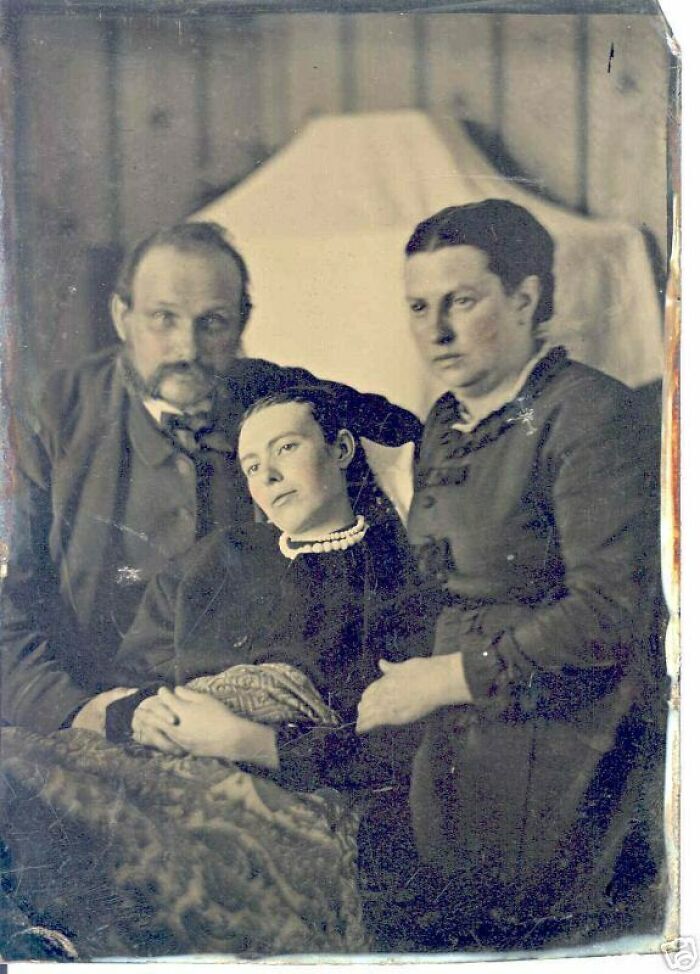
This image, taken during the Victorian era, shows two parents seated beside their daughter, carefully posed as if she were still alive.
While such scenes may feel unsettling today, in the nineteenth century, post-mortem photography was both common and deeply meaningful.
At the time, photography was rare and expensive. For many families, a post-mortem portrait became the only photograph they would ever have of a loved one, especially a child. Infant and childhood mortality rates were high, and loss was a constant reality.
Rather than being hidden, death was openly acknowledged and ritualized within society.
These photographs were often carefully staged to create a peaceful image. The child might be dressed in their best clothing, placed in a crib, seated upright with support, or positioned among family members. In some cases, techniques were used to give the appearance of life, including adjusting posture or enhancing the image after it was taken.
The purpose was not to shock, but to preserve a final memory — a way to remember the person as they were loved.
This practice also reflected broader Victorian attitudes toward grief. Mourning was formal and visible, often lasting months or years. Families wore black clothing, kept personal mementos, and created memorial objects to honor those they had lost.
Post-mortem photography became part of this process, offering a tangible connection to someone who was gone.
To modern viewers, these images can appear eerie. But for the families who commissioned them, they represented care, remembrance, and an attempt to hold onto a loved one in a time when loss came early and often.
Leave a Reply