
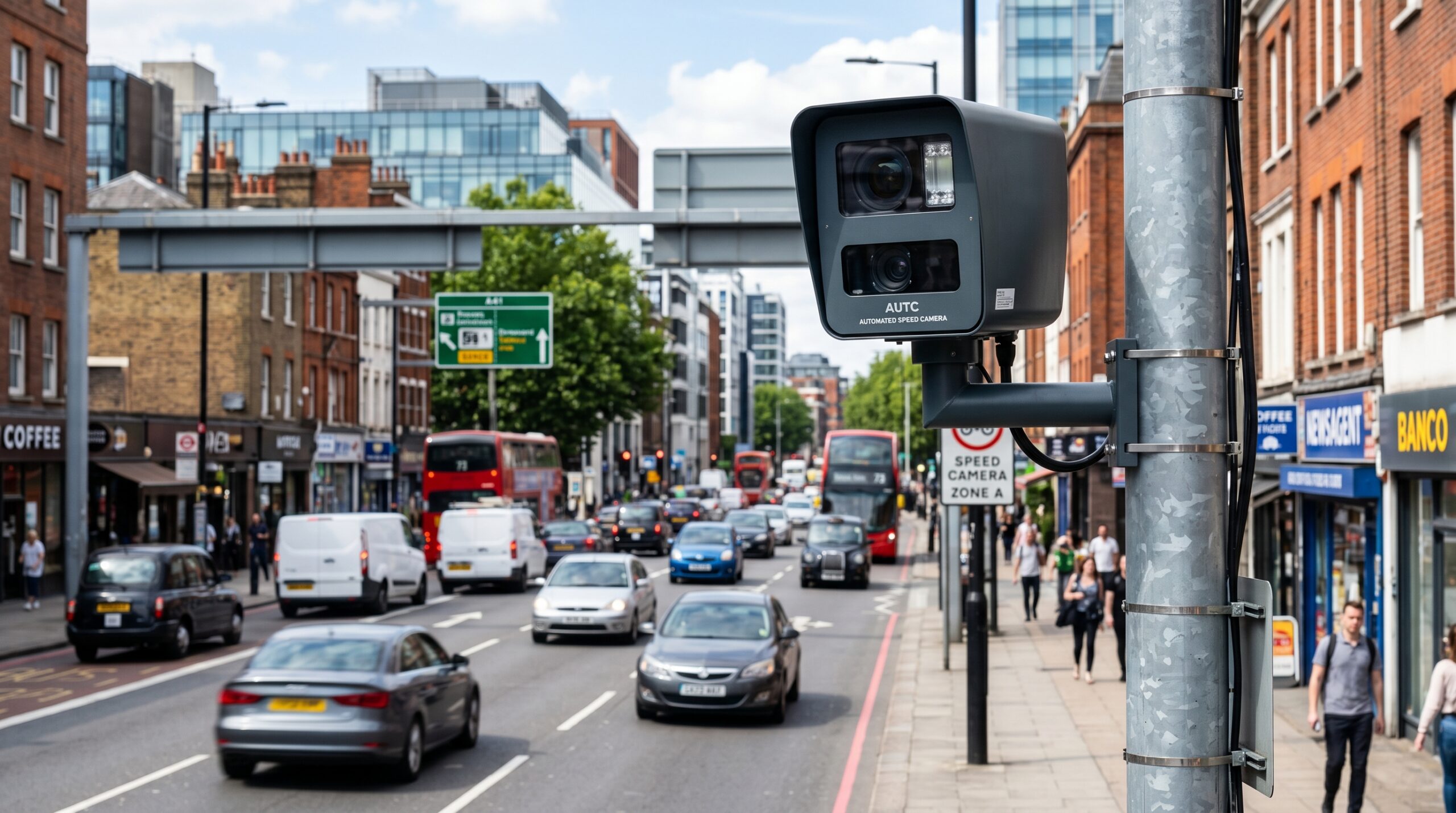
A recent appeals court decision has highlighted the complexities of automated traffic enforcement and the burden of proof required for traffic violations. The District of Columbia Court of Appeals ruled in favor of a driver who contested a speeding fine, determining that the automated camera system’s margin of error created sufficient doubt about whether the violation met the threshold for a higher penalty.
The case centered on a driver caught by an automated speed camera allegedly traveling 61 miles per hour in a 50 mph zone. Under district regulations, driving 11 to 15 miles over the speed limit carries a $100 fine, while exceeding the limit by 10.99 miles or less results in a $50 fine. The critical issue was whether the driver had exceeded the speed limit by more than 11 miles per hour.
The driver, who represented himself throughout the proceedings, argued that the camera’s acknowledged one-mile margin of error meant his actual speed could have been 60.9 miles per hour or less, placing him in the lower fine category. Five attorneys representing the District of Columbia defended the original citation but ultimately lost the appeal.
In its 23-page ruling, the court examined the technical aspects of speed camera accuracy and calibration. Evidence revealed that these cameras undergo testing using tuning forks, a method that verifies the device’s ability to accurately measure speed. Despite this calibration process, the court acknowledged the inherent limitations in precise speed determination.
The court noted a mathematical reality often overlooked in automated enforcement: the impossibility of determining an exact speed down to a precise whole number. A footnote in the ruling stated that the probability of any vehicle traveling at exactly 61 mph, rather than some fractional speed within the camera’s detection range, approaches zero.
This technical uncertainty proved decisive. The appeals court found that when accounting for the camera’s margin of error, there was reasonable doubt about whether the driver had exceeded the speed limit by more than 11 miles per hour. The burden of proof in traffic violations requires establishing the offense beyond reasonable doubt, and the camera’s inherent limitations prevented meeting this standard for the higher fine category.
The case raises questions about the cost-effectiveness of extensive government legal defense for minor violations. With five government attorneys involved in defending a difference of $50 in fines, the resources expended likely far exceeded the monetary amount at stake. However, government agencies often pursue such cases to establish or protect legal precedents that could impact numerous future cases.
The ruling also illuminates the increasing role of technology in law enforcement and the legal challenges that arise from technological limitations. As more jurisdictions rely on automated enforcement systems for traffic violations, courts must grapple with how technological margins of error affect the burden of proof.
For drivers contesting automated citations, the decision suggests that challenging the accuracy and reliability of enforcement technology can be a viable defense strategy, particularly when penalties increase at specific thresholds. The case demonstrates that self-represented individuals can successfully challenge government citations when armed with understanding of the technical aspects of enforcement systems.
The decision may influence how jurisdictions structure their fine schedules and how they account for technological limitations in automated enforcement systems. Some jurisdictions might consider adjusting their policies to account for known margins of error or restructuring penalty tiers to avoid disputes over borderline cases.
Leave a Reply