
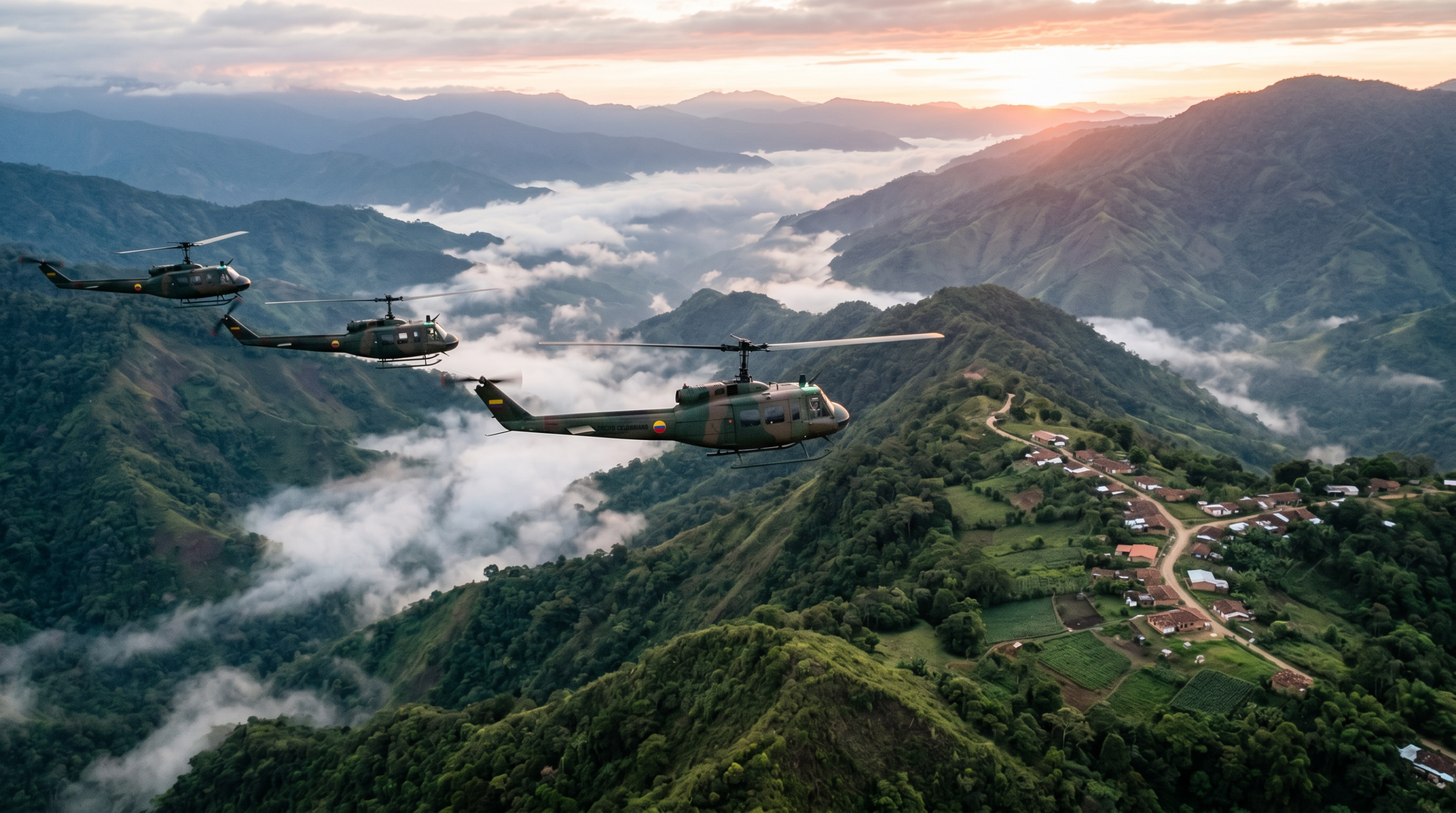
Colombia approaches its presidential election on May 31 against a backdrop of intensifying organized crime violence that will shape the nation’s security strategy for years to come. The country’s criminal landscape has transformed dramatically over the past four years, presenting unprecedented challenges for the incoming administration.
The outgoing administration of President Gustavo Petro implemented significant changes to Colombia’s security approach through his Total Peace policy, which attempted to negotiate with armed groups to reduce violence. His anti-drug strategy initially shifted focus from targeting low-level traffickers to pursuing sophisticated international crime networks and money laundering operations. However, implementation faced substantial obstacles including poor coordination, criminal groups’ adaptability, and pressure for immediate results.
Colombia’s criminal organizations have grown substantially stronger and are engaged in violent territorial disputes across multiple strategic regions. Former Revolutionary Armed Forces of Colombia (FARC) dissident factions have continued fragmenting despite initially uniting for government negotiations. This fragmentation led to the creation of new cells including the General Staff of Blocks and Front (EMBF) and the National Coordinator of the Bolivarian Army (CNEB) in 2024.
According to Glaeldys González, an Andes region analyst at the International Crisis Group, these smaller groups adapt effectively to sustained military operations, making them more flexible and difficult to combat. The National Liberation Army (ELN) also experienced fragmentation, with the Comuneros del Sur splitting off in Nariño department in 2024.
Between 2018 and 2025, Colombia’s main armed groups more than doubled their ranks from approximately 13,000 to over 27,000 fighters, according to the Conflict Responses Foundation. The Gaitanist Self-Defense Forces of Colombia (AGC) experienced the most significant growth, followed by the EMBF and the Central General Staff (EMC), a federation of former FARC rebels.
The incoming administration will inherit more than ten regions currently experiencing criminal conflicts, including Valle del Cauca, Cauca, Nariño, Putumayo, Huila, Meta, Chocó, Antioquia, Bolívar, Norte de Santander, Magdalena, Arauca, and Guaviare departments.
Local communities face increasing pressure from territorial disputes and criminal groups imposing social control. The Catatumbo region exemplifies this crisis, where over 100,000 people have been displaced since January 2025 amid clashes between the ELN and FARC dissidents’ 33rd Front. Communities suffer from confinement, massacres, and targeted killings while armed groups use force rather than negotiation to maintain control.
Technological advances, particularly drone usage, have introduced new dangers for civilians. Armed groups employ drones for surveillance and, in some regions, pack them with explosives for attacks that often harm civilian populations.
Colombia remains the world’s leading cocaine producer, with cultivation increasing from 253,000 hectares in 2023 to 262,000 in 2024. Potential cocaine production rose from 2,664 metric tons to over 3,000 during the same period. Record gold prices have also driven criminal expansion into illegal mining operations across Chocó, Antioquia’s Bajo Cauca region, and the Amazon.
The nation’s security forces face declining operational capacity following years of personnel reductions. Between 2022 and 2024, 355 police officers were removed, leaving the force with its lowest officer count in 15 years. The military experienced similar reductions, with 49 colonels and majors dismissed between February and April 2026.
Gerson Arias, a research associate at the Ideas for Peace Foundation, emphasized that the incoming government will inherit nearly 30,000 armed group members, requiring significant strategic planning regardless of political orientation.
Leave a Reply