
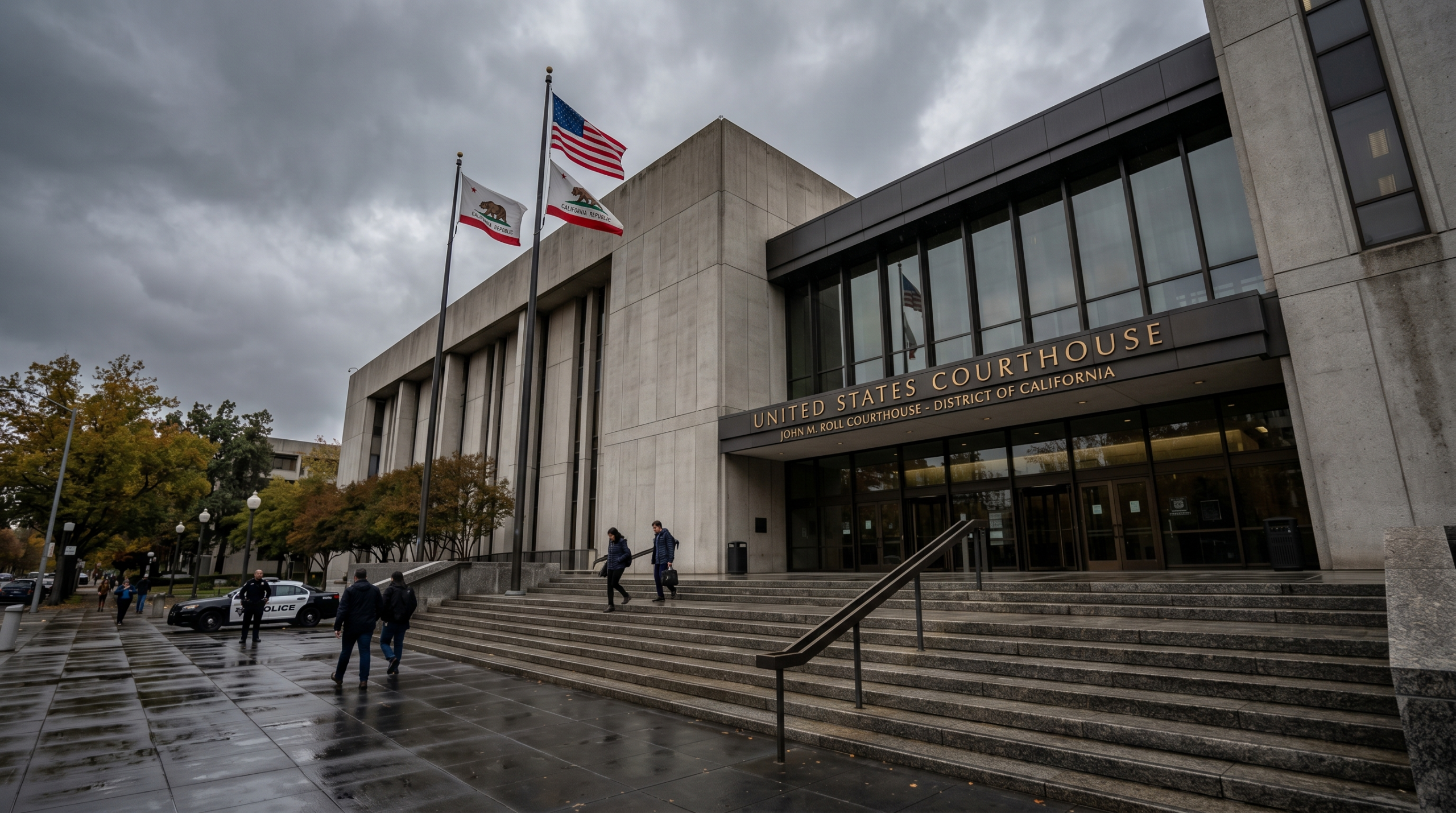
A 23-year-old man accused of killing two people and attempting to murder a third in Davis, California, returned to court Thursday for his second trial after a previous jury failed to reach unanimous verdicts on key charges.
Carlos Reales Dominguez faces charges of second-degree murder in the deaths of David Breaux, 50, and Karim Abou Najm, 20, as well as attempted murder of an unhoused woman. The incidents occurred in 2023 and sent shockwaves through the college town community.
In his first trial last year, jurors acquitted Dominguez of first-degree murder charges, eliminating the possibility of retrial on those counts. However, the jury deadlocked on second-degree murder and attempted murder charges, necessitating a new trial with a different jury.
Prosecutors have shifted their approach for the retrial. Deputy District Attorney Matt De Moura presented a theory of cannabis-induced psychosis to the newly selected jury, arguing that heavy marijuana use triggered dormant mental illness in Dominguez. The prosecution maintains that Dominguez’s cannabis consumption fundamentally altered his behavior and pushed him toward violence.
“Heavy cannabis use can result in that person becoming psychotic,” De Moura told jurors, emphasizing that Dominguez showed no signs of schizophrenia before he began using marijuana. The prosecutor highlighted what he characterized as purposeful, goal-oriented behavior by Dominguez, including fleeing crime scenes and providing false information to police.
Defense attorney Dan Hutchinson countered this narrative, telling jurors that three medical professionals have diagnosed Dominguez with schizophrenia and confirmed he was experiencing psychosis and hallucinations. Hutchinson argued that only one professional, who never interviewed Dominguez directly, supports the cannabis-induced psychosis theory.
The defense painted a picture of a young man whose mental health deteriorated during his first year at UC Davis. Friends and his girlfriend witnessed a dramatic transformation from an athletic, hygienically meticulous student to someone who was thin, neglected personal care, and suffered from hallucinations and delusions.
Hutchinson provided context about Dominguez’s troubled childhood, noting he was born in El Salvador and separated from his parents at a young age. Around age six, human smugglers attempted to bring him to the United States, where he was detained at an immigration facility before being released to relatives in California.
The defense attorney criticized the university’s response to warning signs, stating that while one professor reported concerning behavior after Dominguez wrote a different name on a quiz, no follow-up action was taken.
“Cannabis use was the product of his mental illness,” Hutchinson argued. “It was not the cause of it.”
Dominguez has pleaded not guilty to all charges. At the time of his arrest, the defense maintains he did not believe he had stabbed or killed anyone, which they argue demonstrates the severity of his psychotic state.
The prosecution’s revised theory represents a significant departure from their approach in the first trial, where they argued the killings were motivated by romantic rejection and academic expulsion rather than mental illness. The shift to emphasizing drug-induced psychosis emerged last autumn, according to the defense.
The trial, expected to continue for several weeks, will require jurors to grapple with complex questions about mental state, criminal intent, and the relationship between substance use and mental illness. The outcome could have significant implications for how similar cases are prosecuted in the future.
Leave a Reply