
He thought this was the moment his life would get even worse.
Instead, it became the moment everything changed.
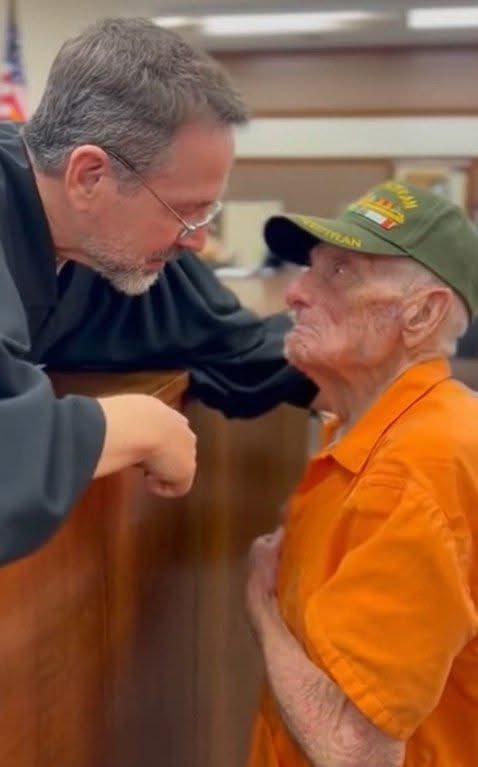
James, an 82-year-old Vietnam veteran, stood alone in a courtroom wearing an orange jumpsuit and the one thing he refused to take off, his old service cap.
For the past three years, he had been homeless.
During a freezing storm, he was found sleeping inside a post office lobby. Disoriented and frightened when officers woke him, he resisted.
That was enough to bring him here.
Trespassing. Resisting arrest.
He stood trembling, barely able to look up, convinced he was about to be sent away again.
But as Judge Stevens reviewed the case file, something stopped him.
It wasn’t the charges.
It was what came after them.
A military record.
Purple Heart.
Bronze Star.
The courtroom went quiet as the judge looked from the file to the man standing before him.
Then he spoke.
“This man isn’t a criminal.”
His voice carried across the room.
“He’s a hero who has been left out in the cold.”
James looked up, confused.
What happened next broke every expectation of what a courtroom usually looks like.
Judge Stevens stood up.
He didn’t reach for the gavel.
He stepped forward.
Leaning over the bench, he reached down, placed his hands on the elderly man’s shoulders, and pulled him into an embrace.
For a moment, time stopped.
James, overwhelmed, leaned into him, holding on.
The same system he believed had abandoned him was now showing something he hadn’t felt in years.
Recognition.
Dignity.
Humanity.
The judge, visibly emotional, spoke again.
“We let you down once when you came home. We won’t let you down today.”
Then he returned to his seat.
“The case is dismissed.”
But it didn’t end there.
Judge Stevens made sure James wouldn’t walk back into the cold. He arranged for him to be taken directly to a veteran support center, where he could receive care, shelter, and the help he had long been missing.
Sometimes justice isn’t about punishment.
Sometimes it’s about remembering who someone was, and who they still are.
Leave a Reply