
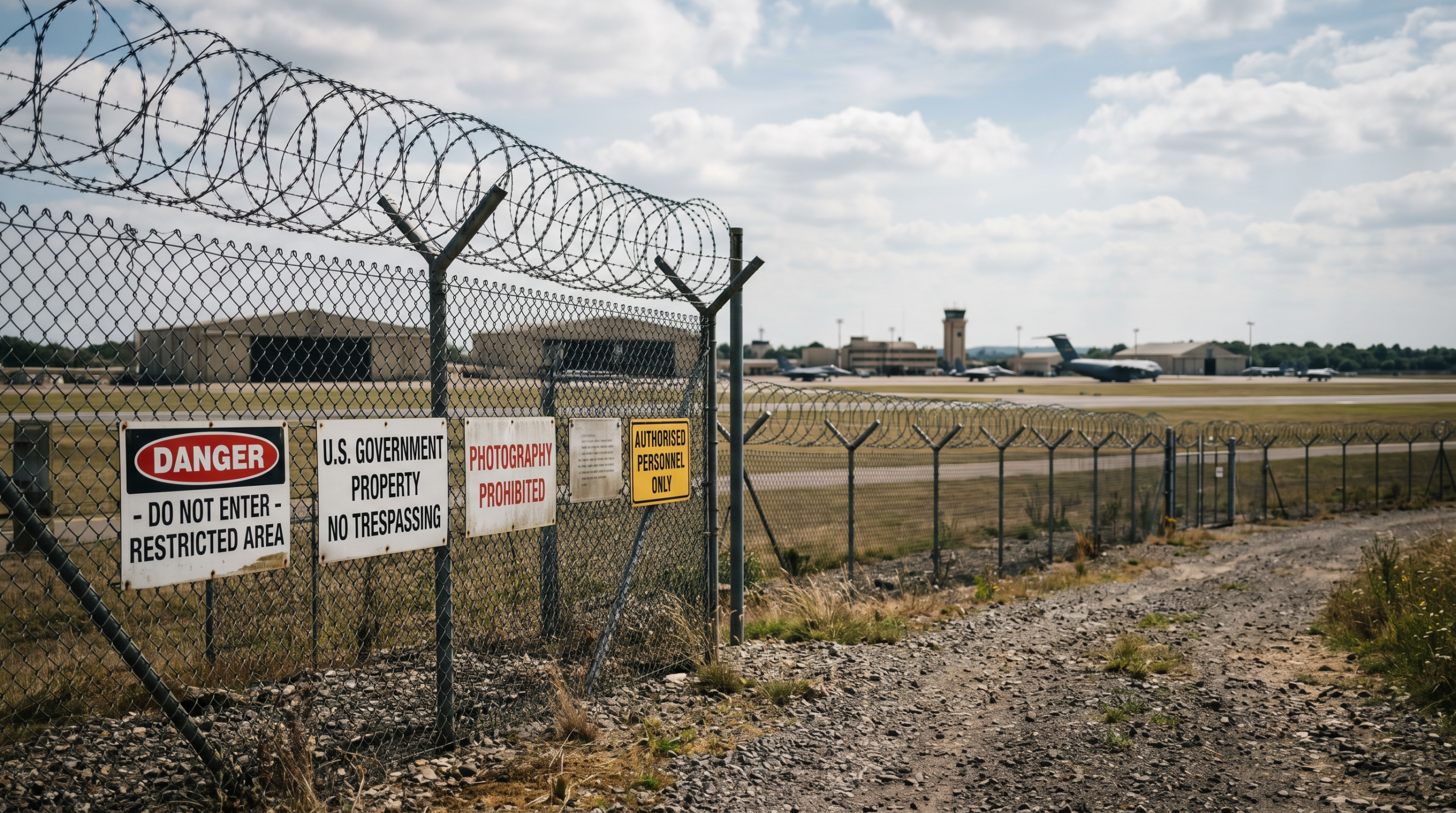
Federal authorities have detained a 21-year-old Chinese national on charges of photographing restricted military aircraft at a strategic United States military installation in Nebraska.
Tianrui Liang appeared before a federal magistrate judge in Omaha on Friday, where he entered a not guilty plea to charges of violating federal laws prohibiting the photography or sketching of defense installations. The Class A misdemeanor carries a maximum sentence of one year in federal prison.
Liang, an aeronautical engineering student at the University of Glasgow in Scotland, was initially arrested on April 7 at John F. Kennedy International Airport in New York City. He had traveled there after being interviewed by federal investigators in Nebraska. Following his initial release, authorities successfully appealed the decision, and Liang was taken back into custody on April 10.
According to court documents, the incident occurred when base security personnel observed an individual outside Offutt Air Force Base in Bellevue, a suburb of Omaha, while military aircraft were positioned on the runway. Security forces and Air Force investigators responded to the scene, where they encountered Liang carrying a camera equipped with a telescopic lens. After determining he held a Chinese passport, military personnel contacted federal law enforcement.
Investigators revealed that Liang had previously visited a military installation in Rapid City, South Dakota, where he reportedly attempted to photograph B-1 bomber aircraft. Court documents indicate he had also planned to visit another military facility near Oklahoma City.
During questioning, authorities inquired about what they described as the “circuitous logistics” of Liang’s travel pattern. His journey began in Vancouver, British Columbia, where he met with a companion. The pair then drove to Billings, Montana, where the companion departed for New York. Liang had planned to leave the vehicle in Kansas City before traveling to Dallas and eventually New York.
Liang acknowledged photographing military aircraft at the Nebraska base, including RC-135 reconnaissance aircraft and E-4B command aircraft. Following the interview, he consented to a search of his electronic devices. Investigators reported discovering multiple photographs of the base’s flight line on his camera.
At Friday’s hearing, federal prosecutor Donald J. Kleine characterized Liang as a flight risk. Magistrate Judge Michael D. Nelson agreed with the assessment, ordering Liang to remain in custody pending a detention hearing scheduled for May 7. The judge noted concerns about the risk of flight despite defense attorney Jeffrey L. Thomas’s assertion that his client had made arrangements to remain in Omaha for the proceedings.
Kleine informed the court that the volume of digital evidence seized from various electronic devices was substantial, requiring prosecutors until May 8 to share discovery materials with the defense.
Liang, who waived his right to a Mandarin interpreter, told the court he had been studying English since age eight in China before pursuing his aeronautical engineering studies in Scotland.
The case has drawn attention due to the strategic importance of the Nebraska installation. The facility serves as the headquarters for U.S. Strategic Command and houses sensitive command-and-control aircraft. The base has historical significance as the site where the B-29 bombers that carried atomic weapons to Japan in 1945 were manufactured at what was then the Glen L. Martin Bomber plant. Following World War II, the installation became central to America’s land-based strategic bomber and missile operations.
While prosecutors have not filed espionage charges, the criminal complaint was authored by an agent from the counterintelligence division, highlighting the national security implications of the case.
Leave a Reply