
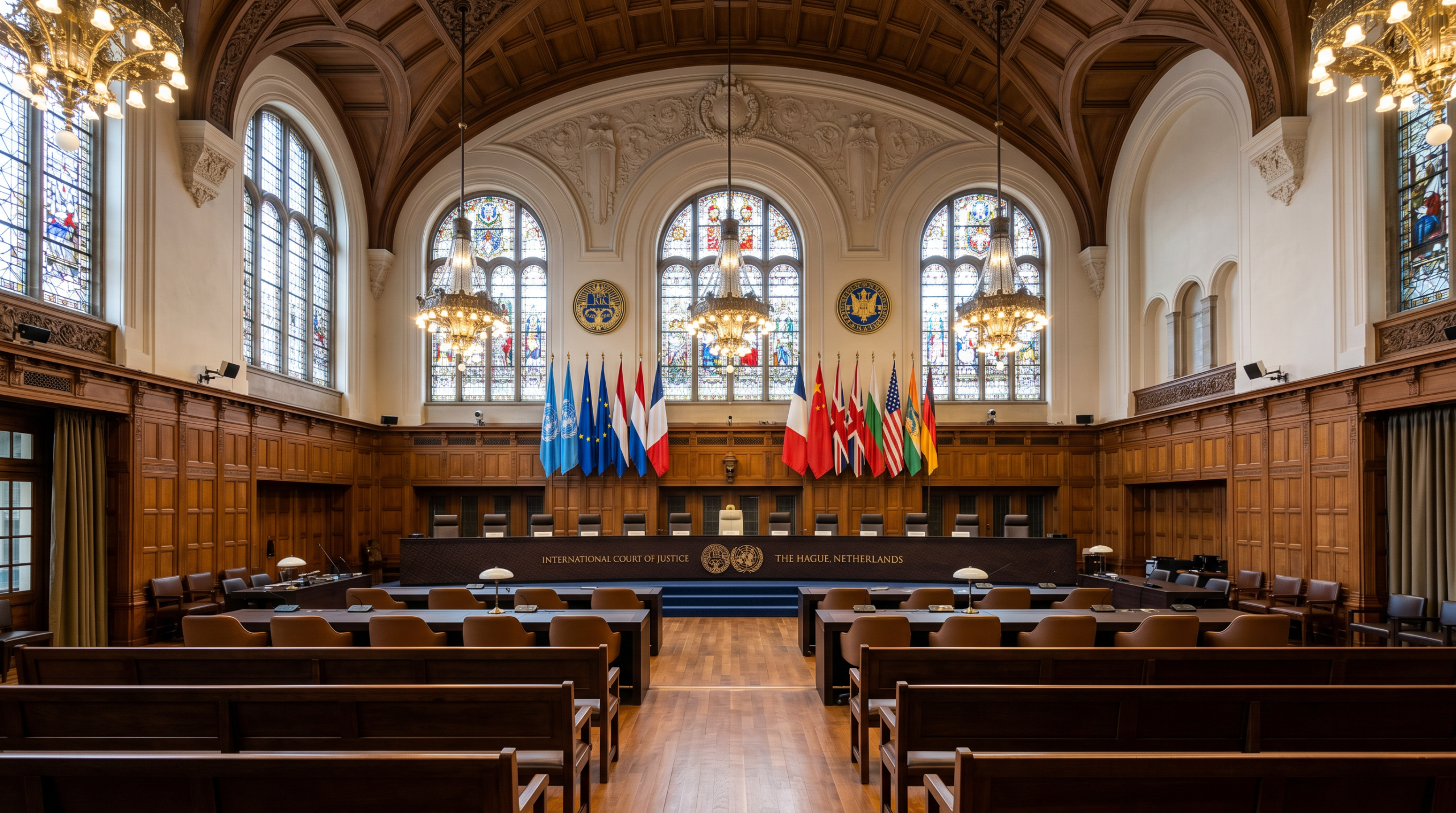
Workers worldwide secured a significant legal victory as the International Court of Justice declared that international law protects their right to strike. The ruling, delivered Thursday in The Hague, resolves a contentious dispute that has divided the International Labour Organization for over a decade.
The conflict originated in 2012 when employer groups within the International Labour Organization challenged the long-standing interpretation that workers’ freedom to organize includes the right to strike. The disagreement escalated to the point where major standards meetings stalled, with employers refusing to discuss cases involving strike rights.
By 2013, employer representatives questioned whether the labor agency’s experts possessed the authority to interpret international labor conventions at all. The deadlock persisted for years without resolution, prompting the labor agency’s governing body to refer the matter to the world court in 2023, following a request from the Workers’ Group supported by 36 governments.
In their ruling, the judges emphasized that strike action represents one of the primary tools workers and their organizations employ to advance their interests and improve working conditions. Rather than focusing on the absence of the word “strike” in the relevant treaty, the court examined how unions operate in practice.
The judges determined that the treaty’s protection of workers’ organizations and their right to organize “activities” and “programs” naturally encompasses strikes, despite the convention never explicitly mentioning them. They dismissed the argument that the treaty’s silence on strikes eliminates the right entirely.
The court stated that a treaty designed to protect workers’ ability to organize and defend their interests cannot reasonably be interpreted as removing one of labor’s most fundamental tools. The judges concluded that protecting the right to strike aligns with the convention’s object and purpose.
However, the ruling leaves several questions unresolved. The International Organisation of Employers emphasized that the court did not define the precise content, scope, or conditions for exercising strike rights. Roberto Suárez Santos, the organization’s secretary-general, expressed employers’ commitment to constructive engagement with governments and workers while urging pragmatic approaches at the upcoming June labor conference in Geneva.
The judges acknowledged that recognizing the right to strike does not determine its extent or what restrictions governments may impose. This means the labor agency’s internal disputes will continue, though the fundamental question has been settled. Future battles will focus on where countries can establish limitations.
The International Labour Organization announced that its governing body will revisit the issue in November to discuss potential next steps following the opinion. This marks only the second time in the organization’s history that it has sought the world court’s interpretation of one of its conventions.
Labor law experts hailed the decision as a major victory for international union rights. Tonia Novitz, a labour law professor at the University of Bristol, described it as recognition that strike action is inseparable from freedom of association and collective bargaining. She noted that judges based their ruling on the treaty text, decades of international human rights law, and regional court decisions recognizing strikes as core democratic protections.
Nicolas Bueno, assistant professor of public international law at UniDistance Suisse, stated that the opinion resolves a long institutional crisis between employers and workers regarding strike rights within the labor agency. He observed that judges applied standard treaty-interpretation rules and suggested the ruling could encourage cooperation on international labor standards.
The advisory opinion cannot be appealed and does not automatically change national labor laws. Some countries, including the United States, never ratified the treaty central to the case. Nevertheless, the ruling establishes an important international legal precedent that will influence labor relations discussions worldwide for years to come.
Leave a Reply