
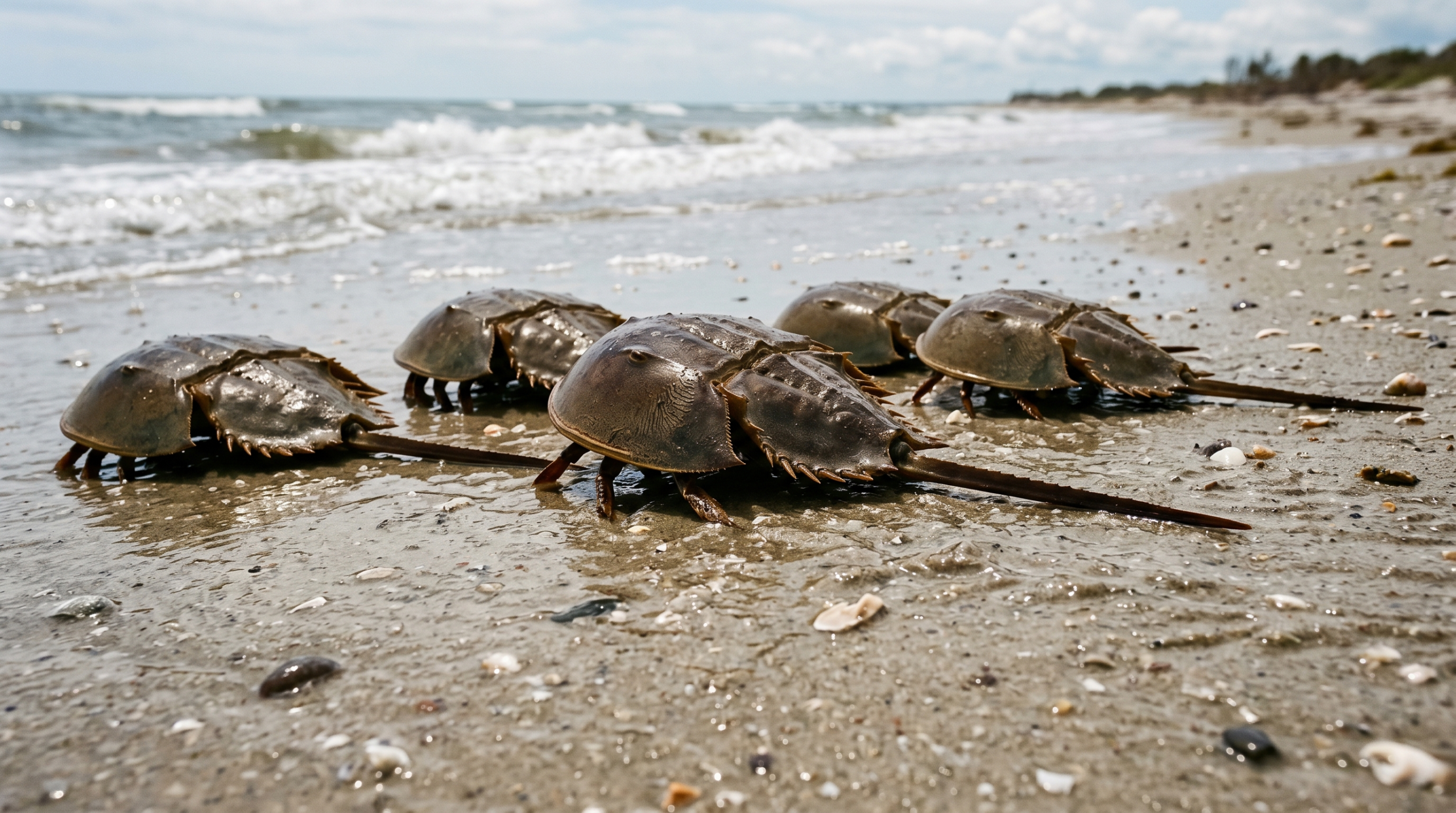
A major conservation organization has initiated legal proceedings against federal authorities following a decision to deny protective status to Atlantic horseshoe crabs under endangered species legislation. The lawsuit, filed in the U.S. District Court for the District of Columbia on Thursday, challenges the National Marine Fisheries Service’s February 18 determination that insufficient scientific or commercial evidence existed to warrant protection for the species.
The horseshoe crab, an arthropod species that has inhabited Earth’s waters for approximately 450 million years, predates dinosaurs by more than 200 million years. These brown, armored creatures possess ten eyes and a distinctive spiked tail, inhabiting shallow estuaries and offshore environments along the Atlantic coastline from northern Maine to Florida, as well as Gulf coast regions extending from Florida to Louisiana and the Yucatán Peninsula.
The legal action seeks a court order compelling the Fisheries Service to issue a new determination that addresses alleged violations of both the Endangered Species Act and the Administrative Procedure Act. According to the plaintiffs, the agency improperly utilized external information and inappropriately segmented the Mid-Atlantic region when evaluating the New York and Delaware Bay populations.
Population data reveals concerning trends for the species. The Delaware Bay horseshoe crab population has experienced a two-thirds reduction since the 1990s. Overall populations have declined by more than 70 percent in recent decades, primarily attributed to biomedical harvesting practices and habitat degradation.
The biomedical industry highly values horseshoe crab blood for its distinctive bright blue coloration and unique properties. The blood contains immune cells that demonstrate exceptional sensitivity to toxic bacteria, making it invaluable for testing vaccines for potential contamination. Data from the Atlantic States Marine Fisheries Commission indicates that approximately 15 percent of crabs perish during the blood extraction process.
Harvesting activities have intensified significantly, with domestic collection doubling over the past seven years. In 2024 alone, more than one million horseshoe crabs were harvested for various purposes. Beyond biomedical applications, commercial fishing operations also harvest these creatures for use as bait in snail and eel fisheries.
The declining horseshoe crab population has created cascading effects throughout coastal ecosystems. Several species that depend on horseshoe crabs for sustenance have experienced population pressures, including endangered sea turtles and various shorebird species. The red knot, a migratory bird that travels 19,000 miles annually between South America and the Arctic, relies heavily on horseshoe crab eggs for nutrition during its journey. This bird species received threatened status under the Endangered Species Act in 2015, with horseshoe crab overharvesting cited as a contributing factor to its decline.
Danny Waltz, a senior attorney representing the conservation group, emphasized the urgency of the situation in a public statement. He noted that while horseshoe crabs have survived numerous extinction events throughout their evolutionary history, including meteor impacts and ice ages, current human activities pose unprecedented challenges to their survival.
The petition for protection, originally submitted in 2024 by a coalition of 26 conservation organizations, outlined multiple threats facing the species, with particular emphasis on habitat loss and unsustainable harvesting practices. The organizations argue that federal protection would provide essential safeguards for both the horseshoe crab population and the numerous species that depend on them for survival.
Leave a Reply