
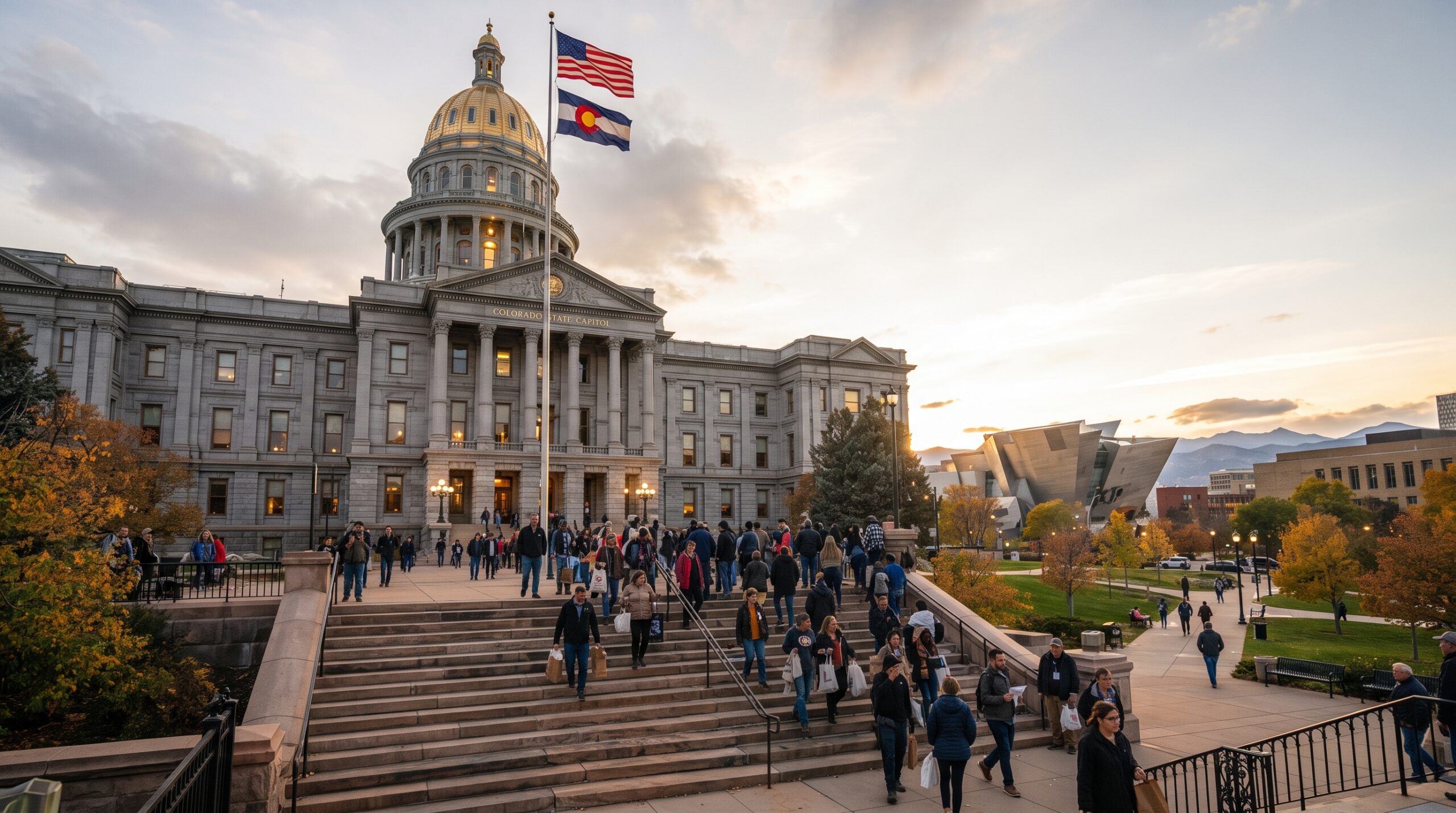
Colorado voters cast 1.5 million ballots on June 30 to determine candidates for the state’s upcoming gubernatorial election in November, with clear divisions emerging between the two major parties.
Attorney General Phil Weiser emerged as the Democratic nominee, securing 56 percent of primary votes. His victory positions him as the frontrunner for the governor’s office, particularly given Colorado’s recent electoral trends favoring Democratic candidates.
The Republican primary remains undecided, with State Senator Barb Kirkmeyer holding a razor-thin lead over Victor Marx of All Things Possible Ministries. Kirkmeyer received 39.94 percent of votes with 186,274 ballots, while Marx garnered 39.65 percent with 184,918 votes. State Representative Scott Bottoms finished third with 20.41 percent.
Marx, a political outsider who claims experience leading over 150 high-stakes missions in dangerous regions worldwide, acknowledged his controversial status within the party establishment. He received endorsements from Congresswoman Lauren Boebert and musician Ted Nugent. Marx developed his own martial art called Keichu-Do, described as a Cajun Christian fighting style.
Kirkmeyer positioned herself as a common sense conservative, distinguishing herself from party hardliners by accepting the 2020 election results and opposing Governor Jared Polis’s decision to commute former Mesa County clerk Tina Peters’s prison sentence in May.
The primary results reflected Colorado’s geographic political divide. Kirkmeyer performed strongly along the Front Range and Denver metropolitan area, while Marx dominated the Western Slope region. Among the 1.5 million total ballots cast, 597,888 came from unaffiliated voters who could participate in either party’s primary.
Political analysts attribute Colorado’s shift from purple to solid blue state status to urban and suburban population growth over the past decade. Wynn Howell, state director for Colorado Working Families Party, noted that urban voter influx has fundamentally altered the state’s political landscape.
Robert Preuhs, chair of Metropolitan State University of Denver’s political science department, interpreted Weiser’s victory as reflecting anti-Washington establishment sentiment. The attorney general emphasized his independence from outside influences during his victory speech, criticizing out-of-state billionaires and special interests attempting to influence Colorado politics.
The Democratic primary also saw surprising results in Denver’s 1st Congressional District, where 29-year-old political newcomer Melat Kiros defeated 15-term incumbent Diana DeGette by a 10-point margin. Kiros, a Democratic socialist, benefited from progressive enthusiasm and anti-establishment sentiment.
However, progressive momentum had limitations. In the U.S. Senate race, moderate incumbent John Hickenlooper defeated progressive State Senator Julie Gonzales, despite Hickenlooper declining to debate his opponent.
The competitive 8th Congressional District presents a crucial battleground. The district, designed to be competitive by a nonpartisan committee, has changed hands in both elections since its creation. Democrat Manny Rutinel won 62 percent of Democratic primary votes to challenge Republican incumbent Gabe Evans in November.
With 40 percent of the 8th District identifying as Latino, immigration policy will likely play a significant role in the general election. The district supported Democrats statewide in 2022 but shifted to support Donald Trump with 50 percent of votes in 2024.
As campaigns pivot toward November, the gubernatorial race will test whether Colorado maintains its recent Democratic trajectory or experiences a Republican resurgence amid national political divisions.
Leave a Reply