
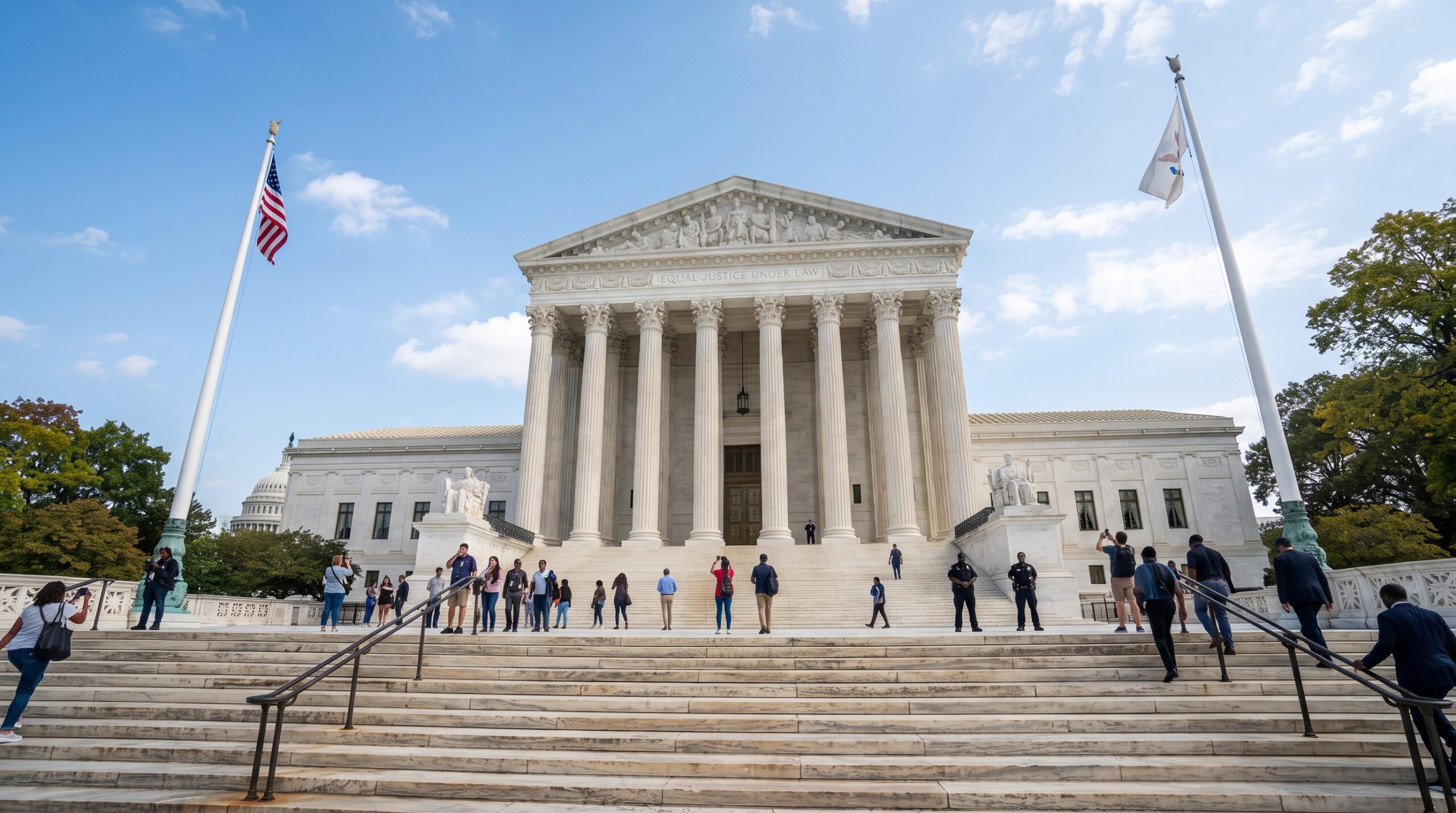
The Supreme Court departed from its standard procedure this week by releasing two separate rulings simultaneously, addressing the scope of presidential authority over federal regulatory agencies while carving out specific protections for the Federal Reserve Board.
Chief Justice John Roberts delivered the paired decisions in Trump v. Slaughter and Trump v. Cook on Monday, breaking from the court’s typical practice of announcing opinions individually. In an unprecedented move, paper copies of both rulings were distributed together in the press room, bound by a rubber band, signaling the court’s intention to have them read as complementary decisions.
The Slaughter case significantly expanded presidential power, granting the president authority to remove commissioners from independent regulatory agencies at will. This ruling affects numerous federal bodies including the Federal Trade Commission, National Labor Relations Board, Merit Systems Protection Board, and Consumer Product Safety Commission. Previously, these commissioners enjoyed protections against termination without cause, which insulated them from partisan political pressure.
However, the Cook decision established a notable exception for the Federal Reserve Board. The case arose from President Donald Trump’s attempt to remove Federal Reserve Governor Lisa Cook. In his opinion, Roberts emphasized the Federal Reserve’s unique position, stating it ‘operates at a deliberate remove from the ordinary political process.’ The chief justice wrote that there was no reason to ‘leave the public in limbo, or to sow doubt as to the status of one of our nation’s most important financial institutions.’
Legal experts suggest the simultaneous release was a strategic decision to prevent market uncertainty. Thomas Berry, director of the Cato Institute’s Robert A. Levy Center for Constitutional Studies, noted that Roberts may have been concerned about potential negative market reactions if there had been a gap between the two rulings’ publication.
The Federal Reserve’s vast influence over both domestic and international economies likely influenced the court’s decision to treat it differently. The institution sets interest rates, manages price inflation, regulates financial conglomerates, maintains financial system stability, and serves as a lender. Economists had warned that subjecting the Federal Reserve to partisan political influence could destabilize markets and potentially trigger a recession.
The rulings revealed divisions within the court. Justices Clarence Thomas, Samuel Alito, Neil Gorsuch, and Amy Coney Barrett joined Roberts in the Slaughter majority but dissented in Cook. Meanwhile, Justices Sonia Sotomayor, Elena Kagan, and Ketanji Brown Jackson dissented in Slaughter but supported the Cook majority. Justice Thomas argued that the legal reasoning between the two decisions was contradictory and suggested the Federal Reserve exception was based on the court’s subjective view rather than legal principle.
Michael Sozan, senior fellow at the Center for American Progress, interpreted the paired release as the court’s acknowledgment of ongoing scrutiny regarding presidential powers. He suggested the justices were aware of criticism about expanding executive branch authority and wanted to demonstrate limits to that expansion.
Brian Frazelle of the Constitutional Accountability Center noted that the decisions aligned with business interests, pointing out that major corporate advocacy groups had supported both expanding presidential power over regulatory agencies generally while maintaining Federal Reserve independence specifically.
The unusual simultaneous release of these decisions highlights the Supreme Court’s awareness of its rulings’ broader implications for both governance and economic stability. By delivering both opinions together, the court attempted to provide clarity on the boundaries of presidential authority while maintaining confidence in crucial financial institutions.
Leave a Reply