
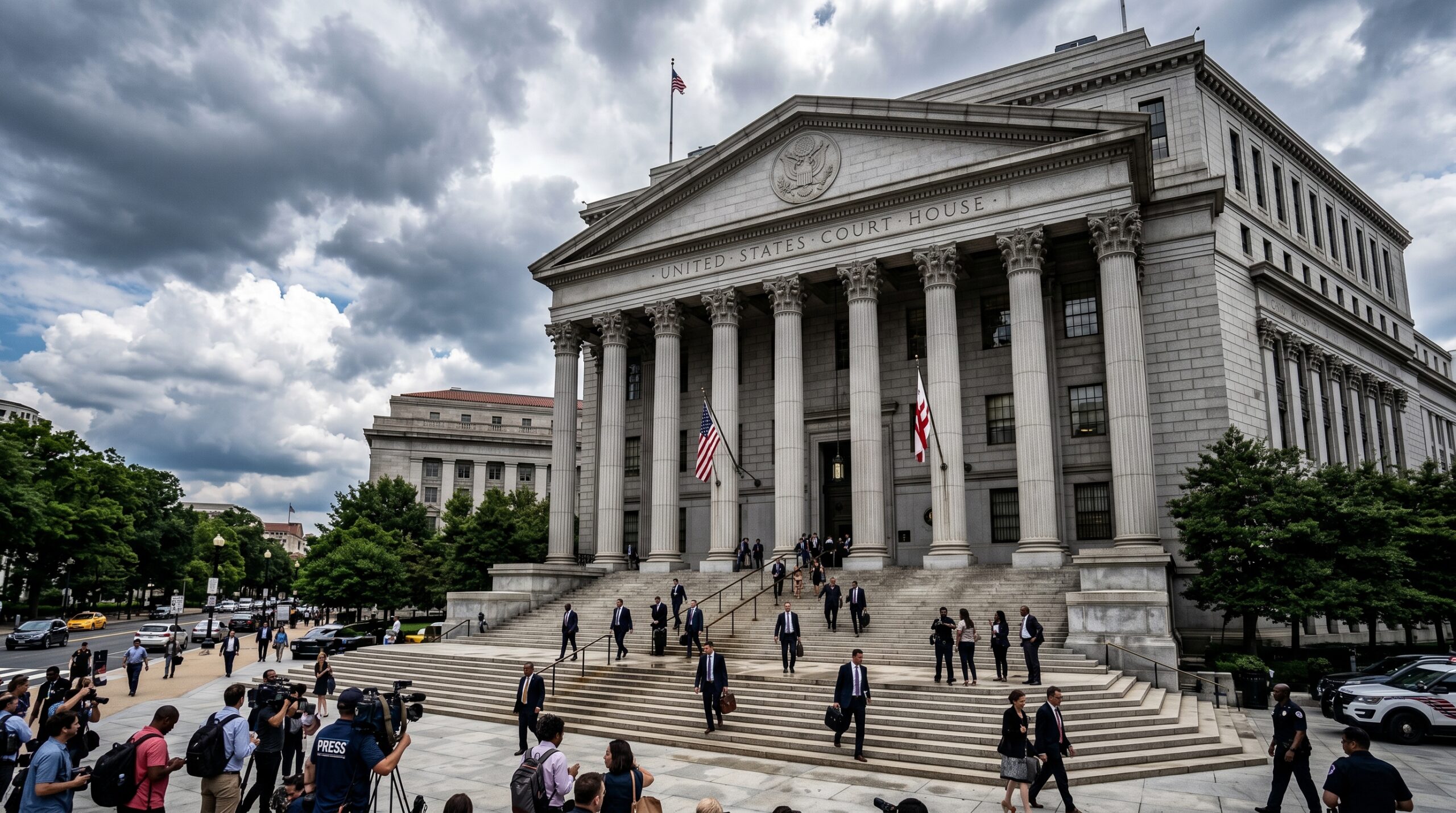
A federal appeals court has declined to reconsider the case of Mahmoud Khalil, a 31-year-old activist facing potential deportation, in a narrow 6-5 decision that highlights deep judicial divisions over immigration detention authority.
The Third Circuit Court of Appeals ruling on Friday rejected Khalil’s request for a full court review, maintaining a January decision that overturned his release from immigration detention. The split decision leaves the former Columbia University student negotiator with limited legal options as he faces renewed detention and deportation proceedings.
Khalil, who holds a green card and whose wife and son are United States citizens, was initially detained in March 2025 by Immigration and Customs Enforcement agents. Authorities cited his involvement in pro-Palestinian advocacy activities, particularly his role as a lead negotiator for student protesters at Columbia University who were advocating for the institution to divest from Israel.
The government’s case against Khalil relies on the Immigration and Nationality Act of 1952, a Cold War-era statute that permits the removal of lawful permanent residents under certain circumstances. The State Department has argued that Khalil’s advocacy activities negatively affected United States foreign policy interests.
During his initial detention, which lasted more than 100 days, Khalil missed the birth of his child. In June 2025, U.S. District Judge Michael Farbiarz in New Jersey ordered his release, determining that Khalil posed neither a flight risk nor a danger to the community while legal proceedings continued.
However, a three-judge panel from the Third Circuit overturned this ruling in January, asserting that the district court lacked the authority to order Khalil’s release. According to the panel, only an immigration judge possesses the jurisdiction to make such determinations.
The Friday ruling revealed significant disagreement among the circuit judges. Six judges voted against rehearing the case, while five supported reconsideration. Judge Cheryl Ann Krause authored a strongly worded dissent, arguing that the majority’s decision undermines the constitutional guarantee of habeas corpus.
“The judiciary serves as an inseparable element of the constitutional system of checks and balances, protecting civil liberties and checking legislative and executive discretion,” Krause wrote in her dissent. “We cannot fulfill that role if we write ourselves out of relevance and leave the executive branch to check itself.”
Judges L. Felipe Restrepo, Arianna J. Freeman, Tamika Montgomery-Reeves, and Cindy Chung joined in supporting a rehearing. The six judges who voted to deny the rehearing were Stephanos Bibas, David J. Porter, Paul B. Matey, Peter J. Phipps, Jennifer L. Mascott, and Thomas Hardiman. The majority did not provide a written explanation for their decision.
Khalil has maintained that the deportation proceedings violate his First Amendment rights to free speech and political advocacy. His legal team argues that targeting him for his political views and peaceful protest activities sets a concerning precedent for lawful permanent residents engaged in constitutionally protected expression.
While Khalil remains free from detention currently, his status is precarious. The Third Circuit must issue a formal mandate directing the lower court to vacate its June 2025 release order before authorities can detain him again. Following Friday’s decision, Khalil immediately requested a stay of that mandate while he prepares to petition the Supreme Court for review.
The case has drawn attention from civil liberties advocates who view it as a test of constitutional protections for non-citizens engaged in political speech. The narrow split in the appeals court reflects broader tensions in the federal judiciary over the scope of judicial review in immigration matters and the balance between executive authority and individual rights.
Leave a Reply