
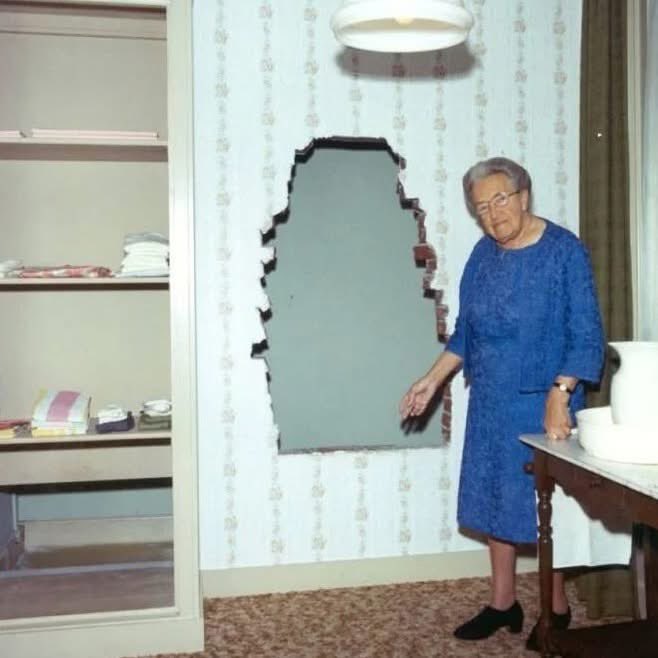
Their home looked ordinary.
A small watch shop in the Netherlands, quietly measuring time like any other.
But behind its walls, something extraordinary was happening.
In 1940, after Nazi forces invaded the Netherlands, Corrie ten Boom and her family made a choice that would change everything.
They chose to help.
Inside their home in Haarlem, they built a hidden room behind a false wall. It was small, cramped, and dangerous, but it became a place of refuge for people who had nowhere else to go.
Jewish families arrived at all hours.
Frightened. Exhausted. Desperate.
The ten Booms took them in without hesitation.
They fed them. Hid them. Helped move them from one safe place to another.
Day after day, year after year, they risked their lives for people they barely knew.
It is believed that more than 800 lives were saved through their efforts.
They weren’t soldiers.
They weren’t part of an organized resistance at the beginning.
They were simply a family who refused to look away.
But in 1944, everything changed.
An informant betrayed them.
The house was raided.
Corrie and her family were arrested.
Her father, already elderly, died shortly after being taken into custody.
Her sister Betsie was sent with her to a concentration camp, where she later died.
Corrie was the only one who survived.
After the war, she chose to speak, not only about the cruelty they endured, but about something far harder to understand.
Forgiveness.
She shared her story with the world, not just to remember the past, but to remind people of what is possible, even in the darkest moments.
The watch shop that once counted seconds and hours became something else entirely.
A place that gave people time.
Time to survive.
Time to live.
Sometimes the most powerful acts in history are carried out by ordinary people who decide that doing nothing is not an option.
Leave a Reply