
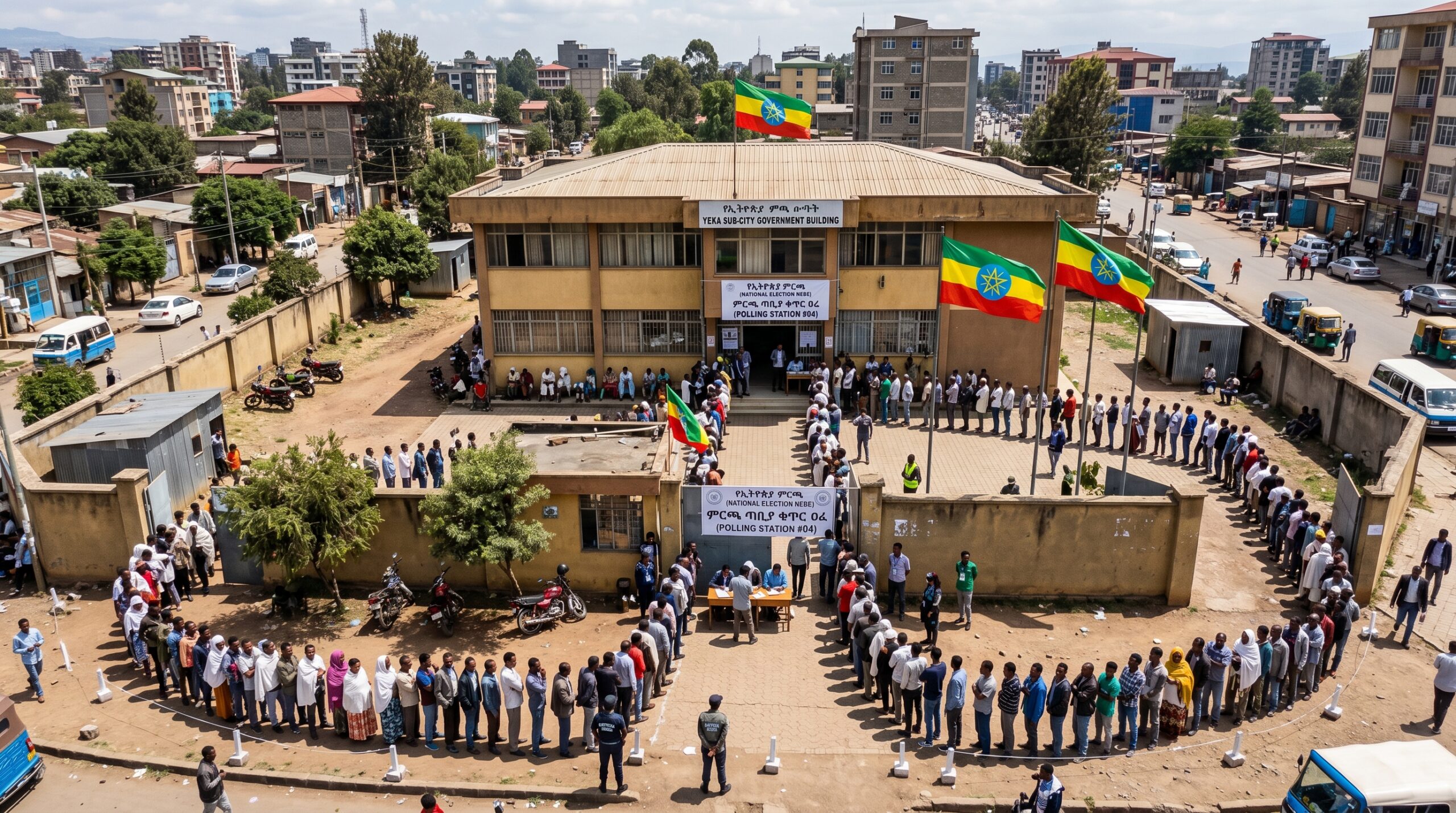
Ethiopia will hold national elections on Monday, with Prime Minister Abiy Ahmed’s Prosperity Party widely expected to secure a commanding victory and extend his leadership for another five years. The ruling party, which currently controls more than 500 seats in the House of Representatives, faces a fragmented opposition landscape that has raised concerns about the democratic process.
Approximately 50 million citizens out of Ethiopia’s 130 million population are registered to participate in selecting members of the House of Representatives. The electoral system allows voters to choose their representatives, who subsequently elect the prime minister. Citizens will simultaneously cast ballots for their regional government council members.
Security challenges in major regions, particularly Amhara and Oromia, may significantly impact voter turnout. The election occurs against a backdrop of ongoing instability in several parts of the country, with a notable military presence observed in the capital, Addis Ababa, during recent days.
The electoral themes center on national reconciliation following conflicts in Tigray, Oromia, and Amhara regions, alongside government pledges to undertake substantial development projects. Former Kenyan President Uhuru Kenyatta, who previously facilitated Tigray peace negotiations, is leading a team of 73 African Union observers monitoring the electoral process. Upon his arrival on Saturday, Kenyatta emphasized Ethiopia’s significance as the host nation of the African Union headquarters.
The Tigray region will not participate in the national election for the second consecutive time, leaving it without federal representation in the 547-seat parliament for six years. The Tigray People’s Liberation Front has been outlawed, though it maintains control of the regional government. This exclusion comes amid reports of severe humanitarian challenges and alleged resource denial by the central government.
Opposition parties have expressed serious reservations about the electoral environment. Mistresilasie Tamerat, head of the Ethiopian People’s Revolutionary Party and the youngest candidate, characterized the process as lacking genuine democratic standards, asserting that the system provides unfair advantages to the ruling party and restricts opposition movements.
Eyoel Solomon, representing the main opposition Ezema party, outlined his organization’s commitment to ending ethnic-based politics, highlighting instances of citizens facing persecution based on their identity and residential location.
The administration has faced criticism regarding human rights practices affecting critics and journalists, contrasting with democratic commitments made in 2020. During Abiy’s tenure, Ethiopia experienced the devastating Tigray conflict, which resulted in hundreds of thousands of casualties before a peace agreement was reached in November 2022.
Abiy received the Nobel Peace Prize in 2019 for resolving longstanding tensions with neighboring Eritrea. However, relations between the two nations have since deteriorated, with Ethiopia accusing Eritrea of supporting rebel groups aimed at destabilizing the country. This situation raises concerns about potential escalation that could draw the Tigray region into proxy conflicts.
Political analyst Bayu Samuel, based in Addis Ababa, suggested that technological improvements in electoral processes and heightened public awareness could contribute to a fair election. However, opposition voices continue to challenge this assessment.
The campaign period has been notably subdued compared to previous elections, with fewer public rallies and limited door-to-door outreach activities. Despite this quieter atmosphere, election discussions have dominated conversations throughout Addis Ababa.
The electoral commission has designated Monday as a national holiday, closing government offices to facilitate voter participation. This decision reflects efforts to maximize turnout despite the various challenges facing the electoral process.
Leave a Reply