
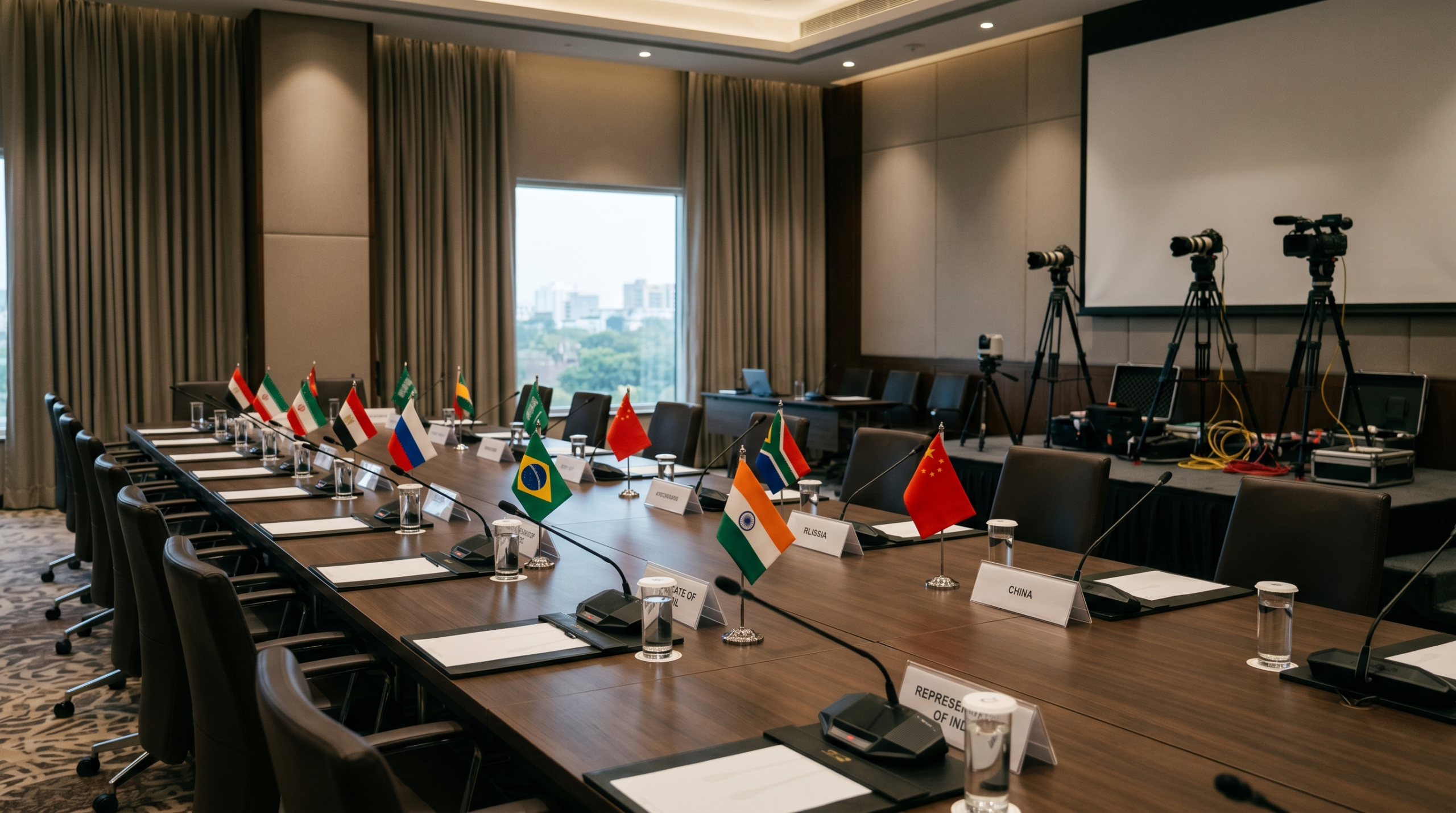
New Delhi — Foreign ministers from the expanded BRICS grouping met in New Delhi on Thursday, with discussions dominated by the war involving Iran and its effects on global energy supplies and shipping routes, India’s foreign ministry said.
India hosted the two-day meeting of foreign ministers from the bloc, which this year includes new members Iran, Saudi Arabia and the United Arab Emirates. India’s Foreign Minister Subrahmanyam Jaishankar opened the talks saying the meeting came amid “considerable flux in international relations,” and citing ongoing conflicts, economic uncertainty and pressures on energy, food, fertilizer and health security.
Among those attending were Iran’s Abbas Araghchi and Russia’s Sergei Lavrov. Jaishankar’s opening remarks, delivered before the start of closed-door sessions, noted that geopolitical tensions and trade, technology and climate challenges were shaping the international landscape.
The conflict that began on Feb. 28 and involves the United States and Israel has heightened volatility in oil and gas markets and disrupted shipping in the Gulf and the Strait of Hormuz, officials said. Those disruptions have added pressure on energy-importing economies, including India, which normally moves about half of its crude through the Strait of Hormuz and is the world’s third-largest oil buyer.
India’s foreign ministry condemned an attack on an Indian-flagged vessel off Oman on Wednesday as “unacceptable,” saying all sailors were rescued safely by Muscat. The ministry said it deplored attacks on commercial shipping and civilian mariners but did not attribute responsibility for the incident.
Speaking in New Delhi, Iran’s Araghchi said the Strait of Hormuz “is open for all” commercial vessels that “cooperate” with Iran’s navy. He told attendees there was “no such thing as a military solution to anything related to Iran,” adding that Iranians “never bow to any pressure or threat” while seeking mutual respect.
The conflict and related fuel uncertainty have strained India’s economy, which relies heavily on Middle Eastern energy and fertilizer imports, and have clouded New Delhi’s growth outlook, officials said. Ship-tracking and import data indicate India has partially offset lost supplies by returning to long-standing partners, expanding ties with new suppliers and reviving sources it had not used in years. Russian crude has been a major backstop during the disruption, even as India spent much of the prior year trying to reduce reliance on Russian supplies amid U.S. tariffs.
Jaishankar met with Lavrov on Wednesday evening and described political cooperation between India and Russia as particularly valuable in a “volatile global environment.” He said discussions covered trade, investment, energy and connectivity.
BRICS began in 2009 as a forum for major emerging economies seeking greater influence in institutions long dominated by Western powers. The original group of Brazil, Russia, India, China and South Africa has since expanded to include Egypt, Ethiopia, Iran, Saudi Arabia, Indonesia and the United Arab Emirates.
China’s Foreign Minister Wang Yi did not attend the New Delhi meeting; officials said he was in Beijing with U.S. President Donald Trump on Thursday. India will host a leaders’ summit later this year, and foreign ministers were scheduled to meet Prime Minister Narendra Modi during their visit, the foreign ministry said.
With notable divisions among members—particularly over the Middle East conflict and criticism of Western powers—officials said it remained unclear whether the meeting would produce a joint communiqué at its conclusion.
Leave a Reply